
Advertisement


Sections
Why China's move to block Brahmaputra tributary is actually linked to Balochistan
China is applying subtle pressure to let India know that the India-Pakistan equation is subject to the complex geo-polity of the South Asian region.

In the wake of India's newly re-imagined policy towards Pakistan — conducting precision strikes across the Line of Control (LoC), reviewing the 'Most Favoured Nation' status tag, and organising high-level meets to discuss withdrawal from the Indus Waters Treaty — China has played its latest card by blocking a tributary of Brahmaputra to facilitate work on of its expensive hydropower projects in Tibet. Power has a lot to do with perception politics and perhaps China intends for this to just be a warning to India, the timing of such a move from China implies that it’s trying to corner India and showing its support for Pakistan.On Friday, 30 September, Xinhua reported that Tibet blocked a tributary of the Yarlung Zangbo River as part of its most expensive hydro project. The 4.95-billion-yuan project ($740 million) can store up to 295 million cubic meters of water.This is not too far-fetched a theory, considering that China is known to displays of aggression across the border when it is unhappy. An earlier Firstpost editorial also points out that such aggression is a part of the Chinese “blow-hot, blow cold” routine. In June this year, the Chinese termed it a "temporary transgression" when about 250 China's Peoples Liberation Army soldiers entered Arunachal Pradesh's east district of Kameng. These incursions are not new and in fact the trend has been rising over the last few years. According to the Indian Ministry of Home Affairs, in 2010, there were 228 incursions, 213 in 2011, 426 in 2012.So how is blocking a tributary of the river in its own legal territory one such show of aggression?[caption id="attachment_3033548" align="alignnone" width="825"]![Image Courtesy: World Bank's Water Initiative]() Image Courtesy: World Bank's Water Initiative[/caption]The Brahamaputra originates in China (Yarlung Tsangpo) and flows through India and Bangladesh; a part of the river’s basin is also in Bhutan. The river basin covers close to 5,80,000 square kilometres through the four countries. The basin, most certainly poses a security concern for India, since both countries have fought over territories in which the river flows. Dam building activities, water diversion plans — with no bilateral or multilateral treaty on these waters — all actors in the issue have their own set of concerns.In the Centre for Naval Analyses 2016 report titled Water Resource Competition in the Brahmaputra River Basin: China, India, and Bangladesh, authors Nilanthi Samaranayake, Satu Limaye, and Joel Wuthnow explain that China’s concerns stem from a fear Indian government’s “actual control” over Arunachal Pradesh (a state it has considered part of China and referred to as ‘Southern Tibet’) can be strengthened through dam-building activities. China’s interests can be inferred as political. However, India’s concerns with any activity upstream (ie in China) is both political and physical. While there is worry over Beijing’s claim to Arunachal Pradesh, probable water diversion or dam building activities in the upper riparian areas of the river could have large scale implications on the physical levelIn 2013, India complained to China about its expensive hydropower projects announced in the Brahmaputra region citing 'irreparable damage' to the Indian basin and also the impact it would have on the physical land and surrounding regions. China didn’t budge, only assured that it wouldn’t have a negative impact.In the ongoing scuffle between India and Pakistan — when both sides are unencumbered in their ways to smear the other as the enemy, China is at an advantage to pick a side. China has in the recent past also unequivocally expressed its support to Pakistan — “In case of any (foreign) aggression, our country will extend its full support to Pakistan,” consul-general of China in Lahore, Yu Boren is quoted as saying in a report published in Dawn. While it may look like China is just being a kind neighbour to Pakistan and supporting it in standing up to a bully like India, but if you look closer there is much more at play here — the China Pakistan Economic Corridor, for instance. H Jacob writes in a paper for the European Council on Foreign Relations, China, India, Pakistan and a Stable Regional Order, that China is “steadily increasing its influence in the region with its innovative ‘New Silk Road’ strategy, and by offering economic and development assistance to Pakistan.”When the Prime Minister Narendra Modi raked up the Balochistan cause in his Independence Day speech, he also loosened the screws on any plans for the China-Pakistan Economic Corridor. China is looking to gain something — by using Gwadar as another naval base (despite Pakistan and China assuring that it will be used only for economic reasons), China will have fresh access to the Indian Ocean (making it a two ocean power) and if the controversy surrounding South China Sea is anything to go by, India is right in being wary of China’s agenda. And China involves itself in the international arguments to further its own cause. So China’s reaction of closing the taps on the Brahmaputra shouldn’t be construed as its big-brotherly act towards Pakistan, considering that India threatened to abrogate the Indus Waters Treaty.China is uniquely aware of Brahmaputra’s importance to lower riparian States like India and Bangladesh and as Brahma Chellaney writes in Coming Water Wars (in The Magazine of International Economic Policy):
Image Courtesy: World Bank's Water Initiative[/caption]The Brahamaputra originates in China (Yarlung Tsangpo) and flows through India and Bangladesh; a part of the river’s basin is also in Bhutan. The river basin covers close to 5,80,000 square kilometres through the four countries. The basin, most certainly poses a security concern for India, since both countries have fought over territories in which the river flows. Dam building activities, water diversion plans — with no bilateral or multilateral treaty on these waters — all actors in the issue have their own set of concerns.In the Centre for Naval Analyses 2016 report titled Water Resource Competition in the Brahmaputra River Basin: China, India, and Bangladesh, authors Nilanthi Samaranayake, Satu Limaye, and Joel Wuthnow explain that China’s concerns stem from a fear Indian government’s “actual control” over Arunachal Pradesh (a state it has considered part of China and referred to as ‘Southern Tibet’) can be strengthened through dam-building activities. China’s interests can be inferred as political. However, India’s concerns with any activity upstream (ie in China) is both political and physical. While there is worry over Beijing’s claim to Arunachal Pradesh, probable water diversion or dam building activities in the upper riparian areas of the river could have large scale implications on the physical levelIn 2013, India complained to China about its expensive hydropower projects announced in the Brahmaputra region citing 'irreparable damage' to the Indian basin and also the impact it would have on the physical land and surrounding regions. China didn’t budge, only assured that it wouldn’t have a negative impact.In the ongoing scuffle between India and Pakistan — when both sides are unencumbered in their ways to smear the other as the enemy, China is at an advantage to pick a side. China has in the recent past also unequivocally expressed its support to Pakistan — “In case of any (foreign) aggression, our country will extend its full support to Pakistan,” consul-general of China in Lahore, Yu Boren is quoted as saying in a report published in Dawn. While it may look like China is just being a kind neighbour to Pakistan and supporting it in standing up to a bully like India, but if you look closer there is much more at play here — the China Pakistan Economic Corridor, for instance. H Jacob writes in a paper for the European Council on Foreign Relations, China, India, Pakistan and a Stable Regional Order, that China is “steadily increasing its influence in the region with its innovative ‘New Silk Road’ strategy, and by offering economic and development assistance to Pakistan.”When the Prime Minister Narendra Modi raked up the Balochistan cause in his Independence Day speech, he also loosened the screws on any plans for the China-Pakistan Economic Corridor. China is looking to gain something — by using Gwadar as another naval base (despite Pakistan and China assuring that it will be used only for economic reasons), China will have fresh access to the Indian Ocean (making it a two ocean power) and if the controversy surrounding South China Sea is anything to go by, India is right in being wary of China’s agenda. And China involves itself in the international arguments to further its own cause. So China’s reaction of closing the taps on the Brahmaputra shouldn’t be construed as its big-brotherly act towards Pakistan, considering that India threatened to abrogate the Indus Waters Treaty.China is uniquely aware of Brahmaputra’s importance to lower riparian States like India and Bangladesh and as Brahma Chellaney writes in Coming Water Wars (in The Magazine of International Economic Policy):
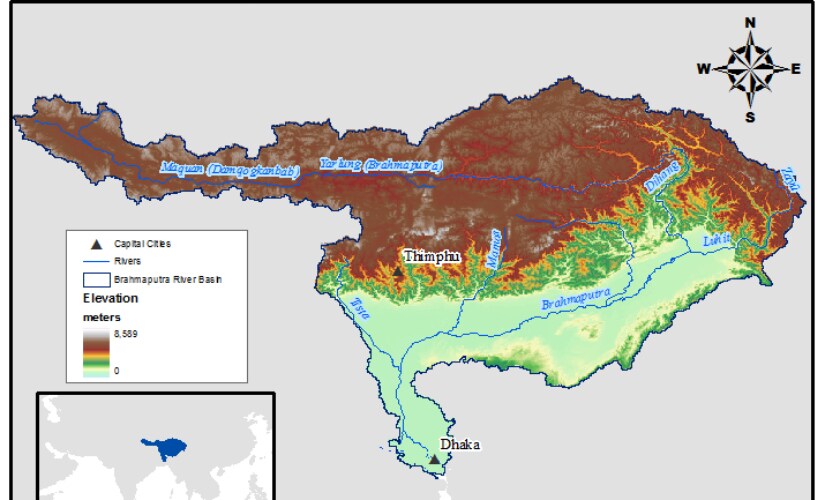 Image Courtesy: World Bank's Water Initiative[/caption]The Brahamaputra originates in China (Yarlung Tsangpo) and flows through India and Bangladesh; a part of the river’s basin is also in Bhutan. The river basin covers close to 5,80,000 square kilometres through the four countries. The basin, most certainly poses a security concern for India, since both countries have fought over territories in which the river flows. Dam building activities, water diversion plans — with no bilateral or multilateral treaty on these waters — all actors in the issue have their own set of concerns.In the Centre for Naval Analyses 2016 report titled Water Resource Competition in the Brahmaputra River Basin: China, India, and Bangladesh, authors Nilanthi Samaranayake, Satu Limaye, and Joel Wuthnow explain that China’s concerns stem from a fear Indian government’s “actual control” over Arunachal Pradesh (a state it has considered part of China and referred to as ‘Southern Tibet’) can be strengthened through dam-building activities. China’s interests can be inferred as political. However, India’s concerns with any activity upstream (ie in China) is both political and physical. While there is worry over Beijing’s claim to Arunachal Pradesh, probable water diversion or dam building activities in the upper riparian areas of the river could have large scale implications on the physical levelIn 2013, India complained to China about its expensive hydropower projects announced in the Brahmaputra region citing 'irreparable damage' to the Indian basin and also the impact it would have on the physical land and surrounding regions. China didn’t budge, only assured that it wouldn’t have a negative impact.In the ongoing scuffle between India and Pakistan — when both sides are unencumbered in their ways to smear the other as the enemy, China is at an advantage to pick a side. China has in the recent past also unequivocally expressed its support to Pakistan — “In case of any (foreign) aggression, our country will extend its full support to Pakistan,” consul-general of China in Lahore, Yu Boren is quoted as saying in a report published in Dawn. While it may look like China is just being a kind neighbour to Pakistan and supporting it in standing up to a bully like India, but if you look closer there is much more at play here — the China Pakistan Economic Corridor, for instance. H Jacob writes in a paper for the European Council on Foreign Relations, China, India, Pakistan and a Stable Regional Order, that China is “steadily increasing its influence in the region with its innovative ‘New Silk Road’ strategy, and by offering economic and development assistance to Pakistan.”When the Prime Minister Narendra Modi raked up the Balochistan cause in his Independence Day speech, he also loosened the screws on any plans for the China-Pakistan Economic Corridor. China is looking to gain something — by using Gwadar as another naval base (despite Pakistan and China assuring that it will be used only for economic reasons), China will have fresh access to the Indian Ocean (making it a two ocean power) and if the controversy surrounding South China Sea is anything to go by, India is right in being wary of China’s agenda. And China involves itself in the international arguments to further its own cause. So China’s reaction of closing the taps on the Brahmaputra shouldn’t be construed as its big-brotherly act towards Pakistan, considering that India threatened to abrogate the Indus Waters Treaty.China is uniquely aware of Brahmaputra’s importance to lower riparian States like India and Bangladesh and as Brahma Chellaney writes in Coming Water Wars (in The Magazine of International Economic Policy):
“Upstream dams, barrages, canals, and irrigation systems can help fashion water into a political weapon that can be wielded overtly in a war, or subtly in peacetime to signal dissatisfaction with a co-riparian state.”China is applying subtle pressure to let India know that the India-Pakistan equation is subject to the complex geopolitics of the South Asian region. The two nations should perhaps engage in cooperation and dialogue, like they did in the early 2000s after a major flood hit the North East of India. Sure, talking about a river that flows through contested territory is not easy, but better than escalation that neither country should attempt.
Cultural anthropologist with a terrific nose for news. Obscure music hound. Rarely bored — always scrolling, always reading.
First Published:Oct 04, 2016, 13:09:10 IST
Advertisement
Advertisement

China has dominated Myanmar’s rare earth mines — now India eyes deal to harness country’s critical minerals
India is deepening rare earth cooperation with Myanmar as New Delhi seeks alternative sources of critical minerals dominated by China, including dysprosium and terbium used in EVs, defence systems and clean energy technologies
6 min read
CJP protest in Delhi: New videos of stone pelting, violence emerge as police, agitators trade charges
Fresh videos of violence that broke out during the Cockroach Janta Party's (CJP) protest in Delhi have surfaced, with the police releasing footage showing alleged stone pelting, vandalism and attacks on security personnel
3 min read
'From make in India to launch from India': Skyroot COO on why Vikram-1 could change India’s space sector
Skyroot Aerospace’s successful Vikram-1 mission marks a major milestone for India’s private space sector, as the country seeks to shift from “Make in India” to “Launch from India” and compete in the global commercial satellite launch market
8 min read
Choke terror funding, keep international shipping lanes safe: Jaishankar at Asean Regional Forum
Jaishankar's remarks came against the backdrop of recent terror attacks targeting India and growing threats to commercial shipping amid conflicts in West Asia and Europe
2 min read
PM Modi announces fast-track courts for paper leak cases; CJP responds ‘Dharmendra Pradhan must go’
Amid protests demanding accountability for the leak of medical entrance test Neet and other irregularities in the education system, Prime Minister Narendra Modi has announced that the government has decided to set up fast-track courts to ensure swift and stringent punishment for those involved in paper leaks.
3 min read
Advertisement
Advertisement