


Not Burhan Wani, it's Pakistan's proxy war that's behind Kashmir tragedy
The violence in the Kashmir Valley — that has so far claimed 20 lives and injured over 200 — following the elimination of Burhan Wani by Indian security forces is deeply tragic but in no way unexpected

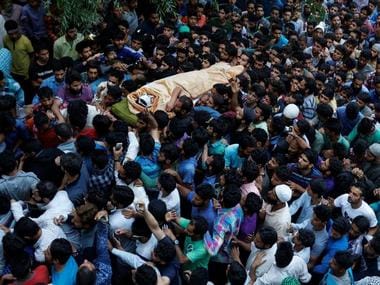
Kashmiri Muslims carry the body of Burhan Wani, a separatist militant leader, during his funeral in Tral, south of Srinagar. Reuters[/caption]Besides, it would be too simplistic to assume, as a section of the media has done, that the 'spontaneous' outpouring of grief for the 21-year-old slain terrorist and the resultant violence against security personnel stem solely from Wani's social media popularity and his 'iconic' status as the local poster-boy of armed rebellion. Seeing the renewed clashes through rose-tinted glasses of misplaced romanticism as a "freedom movement of Kashmiris determined to secede from an oppressive Indian State" would be to turn a blind eye to evidences of history and Pakistan's stated machinations behind the turbulence.The seeds of Pakistan-sponsored insurgency in Kashmir were sown in the mid-1970s when Lieutenant-General Hamid Gul, former ISI chief who nurtured a deep and enduring animosity against India having suffered two humiliating losses in 1965 and 1971 wars, set up militant groups in the valley to train young Kashmiris and Afghans to fight in India.By 1991, the Jammu Kashmir Liberation Front (JKLF) had a ready army of Kalashnikov-wielding men roaming the lanes and bylanes of Srinagar, Baramulla, Anantnag and Sopore, calling for azaadi from "Indian rule". That the armed insurgency came a cropper by 1996 owes in no small measure to Indian army's determined, sustained counter-offensive and ISI's cutting off of weapons and training aid to JKLF in favour of Hizbul Mujahideen, which had a more pro-Pakistan slant unlike the pro-independence JKLF.Fidayeen attacks, masterminded by the ISI-sponsored Lashkar-e-Taiba and Jaish-e-Mohammed terrorists marked the second wave of violence which reached its peak between 1999 and 2002. As professor Sumantra Bose writes in Al Jazeera, "at least 55 such attacks took place and 161 military, paramilitary and police personnel died, as did 90 perpetrators." Coming just after the Kargil conflict, the suicide attacks culminated in the daring 2001 Parliament attack.After a lean phase since early 2003, insurgency reared its head again in towards the later part of the decade. Clashes in 2008 and again in 2010 claimed over 100 lives each as the cycle of violence continued unabated.Between January 1990 and April 2011, government data show that in the last 21 years, 43,460 people have been killed in the Kashmir insurgency. Of these, 21,323 were terrorists, 13,226 were civilians killed by terrorists, 3,642 civilians killed by security forces and 5,369 policemen killed by terrorists. The 21,323 terrorists include both Kashmiri and foreign militants. The hard truth is, terrorists slaughtered more civilians than Indian security forces ever did.It has been speciously suggested that Wani single-handedly sexed up local militancy in Kashmir which was on the wane.Indian Express, just to take one example among the many media outlets taking a similar line, quoted a Kashmiri police officer as saying: "There are so many stories woven around Wani that he has become a legend across this region. For almost 15 years, Kashmiri youngsters refrained from joining the militant ranks. Burhan brought the militant movement back to youngsters here… Earlier, local recruits would be sent across the border for arms training. After Burhan became known, we have witnessed a new situation. There are more than 60 local militants active in south Kashmir who have trained locally," said the officer.This narrative — built around a terrorist who obviously was good at marketing himself through social media tools — by a gullible media and opportunistic politicians such as Omar Abdullah who stand to gain by keeping the Kashmir cauldron boiling, discounts Pakistan's role behind another wave of insurgency.By making Wani a youth icon and a hero and glorifying his role in insurgency, the media is also ending up propagating Pakistan's cause. Islamabad is already portraying the Hizbul commander as a "martyr" and is calling for a plebiscite in the Valley due to "India's human rights violations".For Pakistan, Kashmir is an unfinished business, the focal point of "1,000 years of war" against India and rallying platform for a clash of civilisations. Its Army does not want the Kashmir issue to be resolved as this would pose a serious challenge to its existence and dominance in the country's political set-up.An audio clip, purportedly the voice of Burhan's mother, being circulated in Kashmir in the aftermath of violence has her shouting: "Tum kitne Burhan maaroge?". A crowd responds, "Har ghar se Burhan niklega." Then the crowd takes over: "… (not intelligible) aage badho, hum tumhare saath hain. Jeeve jeeve Pakistan. Jeeve jeeve Pakistan. Jeeve jeeve Pakistan. Jeeve jeeve Pakistan."For all the theories about Wani inspiring a "purely local militancy," here are a few facts. According to Indian Army records, at least 70 young Kashmiris in 2014 joined the secessionist movement with most aligning with the banned group LeT.How many local Kashmiri youths were recruited by the "formidable" Wani?

China has dominated Myanmar’s rare earth mines — now India eyes deal to harness country’s critical minerals
CJP protest in Delhi: New videos of stone pelting, violence emerge as police, agitators trade charges
'From make in India to launch from India': Skyroot COO on why Vikram-1 could change India’s space sector
Choke terror funding, keep international shipping lanes safe: Jaishankar at Asean Regional Forum
PM Modi announces fast-track courts for paper leak cases; CJP responds ‘Dharmendra Pradhan must go’