


Armed forces welcome Rajnath Singh as defence minister; experience from CCS, internal security likely to aid him in new job
The cheer so evident in military circles on Rajnath's appointment as defence minister has two aspects as its basis, the first of which relates to the allegation that the armed forces were perceivably ill-treated under the previous NDA government

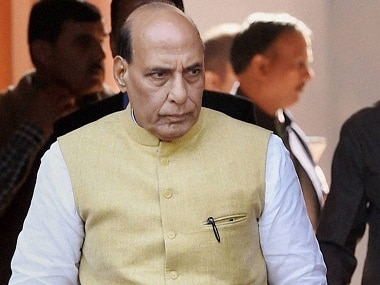
File image of newly appointed Defence Minister Rajnath Singh. News18[/caption]The cheer so evident in military circles on Rajnath's appointment as defence minister has two aspects as its basis, the first of which relates to the allegation that the armed forces were perceivably ill-treated under the previous NDA government. Issues such as the implementation of 7th Pay Commission which has virtually downgraded their status, One Rank One Pension (OROP) which has far too many complexities of interpretation, the nonfunctional financial upgrade (NFFU) which is available to all other central government services except the Armed Forces, and the opening of cantonments to civilian traffic and movement with nary a thought to the security involved have created the perception that the government can only flog the military but not support it. The latest bombshell involving further restrictions on purchase of motor cars from the Canteen Stores Department may have many technical issues involving financial management. However, the significance of the fact that erosion of existing facilities is rapidly taking place lowers morale. With no such restriction on the CAPFs through their canteen system, the armed forces are clearly peeved by the comparison.Secondly, they perceive that without a heavyweight political figure in charge of the Ministry of Defence (MoD) none of their grievances are going to be addressed by the government. Rajnath is the second senior most in the pecking order of the Cabinet and therefore his say automatically makes a difference.Rajnath is familiar with all the internal security issues of the country. He will now have to familiarise himself with external security. More importantly, he is expected to give some impetus to the acquisition system and help reduce military imports, a field completely alien to him. In the MHA, he had the advantage of working with experienced police officers, who made up the majority of the bureaucracy. But that's not the case here.A proposal to integrate the MoD on the basis of existing models in most of the significant countries around the world has been languishing for two decades. If implemented, it will bring officers of the armed forces to occupy appointments alongside bureaucrats in the MoD. It will also help to promote mutual trust and greater professionalism among the Services community and the bureaucracy. The restructuring of the armed forces to meet modern day threats is ongoing but larger decisions such as the one on the appointment of the Chief of the Defence Staff (CDS), the theaterisation of field commands, restoration of the Indian Air Force to a 42 squadron force (from the current 32 ) and making the Indian Navy equipped and trained for its assigned new role in the Indo-Pacific are all issues that Rajnath is well aware of, having been a part of the Cabinet Committee on Security (CCS) as the former home minister. As a member of the CCS, he has had more experience in five years than most ministers can boast of in a lifetime. The crisis situations in the tenure of the previous government were challenging enough: the Manipur ambush and response in 2015, the Burhan Wani killing and its aftermath leading to Uri 2016, ending with the surgical strikes, the Doklam stand off for 72 days in 2017 leading to the Wuhan summit 2018 and stabilization of Sino Indian relations, and finally the Pulwama suicide bombing, the response by the IAF at Balakote and the escalation spiral in 2019. No defence minister in the past appears to have come to office with such a rich exposure at the CCS, except perhaps Pranab Mukerjee in 2004.Not to be missed out is the fact it is in his tenure as home minister that Jammu and Kashmir witnessed Operation All Out, the combined operation of the army, local police and the CRPF which has succeeded in good measure in neutralising a large number of terrorists since early 2017. It is unlikely that as HM he ever visited the establishments of the army in Jammu and Kashmir, which technically were outside his purview. He should change this policy and ensure that the home and defence ministers demonstrate joint efforts of the army and police forces, by frequent visits to establishments and organisations of both. Functioning in compartments, especially in Jammu and Kashmir has been the bane of the system which has marginally improved in recent years and could see better days under Rajnath.The armed forces must prioritise well the issues they wish to familiarise the new defence minister with. The MoD is simply too complex and too mind boggling for any new entrant, including the raksha mantri himself. On his part, what Rajnath has to realise is that the armed forces are a house divided, where turf protection is high on the agenda of individual services. The level of confrontation between the bureaucrats and the armed forces fraternity has reached dangerous levels and it is now becoming counterproductive, weakening national security. A civil-military relationship of mutual respect is something he will have to work on and given his personality he is quite capable of achieving.The key to success of a defence minister is also the ability to ignore certain issues of military culture and way of life which neither the political community nor the civilian bureaucracy can easily understand. The military community is proud of its apolitical approach and likes to maintain its strictly guarded value system through limited contact with the environment. The decision of the previous NDA government to open cantonments to civil traffic was a spoiler in chief which gave an impression to the military community that the government had little interest in the nurturing of military culture, away from influence of extraneous factors.Hopefully it will be full five year tenure for Rajnath as raksha mantri and the MoD will witness momentous changes that have been expected for decades. He has great opportunities knocking at his doorstep. The cheer and positivity with which he is being welcomed by the military community augurs well for a highly successful tenure.

India rejects Pakistan's 'baseless' claims at Asean, says Indus Waters Treaty to remain on hold
India successfully tests long-range 'Kusha' air defence missile system
Indian trucker arrested in US over alleged theft of $3 million worth of tungsten powder
China has dominated Myanmar’s rare earth mines — now India eyes deal to harness country’s critical minerals
CJP protest in Delhi: New videos of stone pelting, violence emerge as police, agitators trade charges