Acquiring toys like bullet train won't alter country's mindset: India must change, and if required learn to be modern
In India, people seem to believe that by acquiring toys like bullet trains it will become a modern nation. That is not true. For that to happen the society must change,
India has begun the execution stage of its bullet train project. There have been reports of problems during land acquisition along the Mumbai-Ahmedabad pathway but let’s hope it all gets sorted out. This is being written on the assumption that the train project will actually take off soon.There are bound to be some obstacles in a project of this size but hopefully, these are minor. And if everything goes well, India will see the bullet train operational in a few years with foreign assistance and technology.
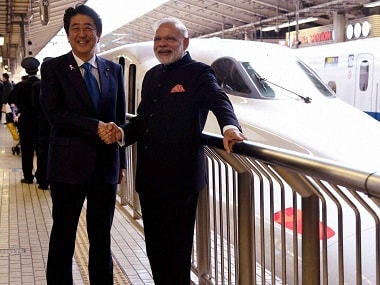
A file image of Prime Minister Narendra Modi with his Japanese counterpart Shinzo Abe. PTIJapan has been running the bullet train for over 50 years and it covers the entire country. A couple of years ago, the remote north-eastern state of Hokkaido was also made accessible by bullet train. This was after the construction of a tunnel under the sea.Japan is, in my opinion (I have visited twice for lengthy stays), the single most advanced society in the world. It is more advanced than Europe without a doubt and certainly far more advanced than China. By advanced, I mean that its people are the most modern. This is why their technology is modern. Not the other way around. Japan is not modern because its population uses fancy gadgets.Secondly, their people are not modern because they operate in English. In fact, almost nobody speaks English in Japan, as visitors will know. But this does not stop them from having a very easy experience of the country because the people are modern. Their modernity shows in their design and culture. Japan is the easiest country in the world for the tourist to navigate. This is because the Japanese focus on design excellence.Let me give a few examples. Many Japanese wash basins also double up as the toilet cistern. Meaning that the wastewater you use to wash your hands is the same that then fills up the cistern and is used in the flush. This is a simple idea. It probably saves about 30 percent to 40 percent of water in a toilet. But I know of no other society that has thought of this idea and uses it.In the Japanese Shinkansen (bullet train) in front of your seat, meaning behind the backrest of the passenger in front of you, is a little metal slot. This is for you to put your ticket so that if the conductor comes when you are sleeping, he or she does not have to wake you to check it. It is a logical and low-cost idea that respects your sleep and the conductor’s time.Also on the trains, the seats can easily be turned around to face one another. So if a family of six is travelling together, they can swivel one entire row of three seats and make it face backward. This way, all can sit facing each other instead of facing the same way. Again, simple but thoughtful.I have travelled to many countries in the world but I have not seen this degree of design quality and efficiency. The Japanese are constantly thinking about ways, small ways, to improve processes and products. It is claimed that this attitude was imported by an expert in America. I find that difficult to believe. I don’t doubt that a management consultant named Deming came to Japan to show their industry a few techniques. What I mean is that the culture and attitude of Kaizen (the Japanese word that refers to these gradual improvements) was already present in the country.Japan was kept deliberately closed to the outside world by its rulers till 165 years ago. Just before this, it was already prosperous by Asian standards. It grew a surplus of rice (after importing a good strain of rice from India). But the great leaps have all been made in the last century or so. More than 50 percent of the world’s bullet train passengers are Japanese. They have had zero fatalities in over 50 years, meaning not a single person killed on a Shinkansen crash though crores of people have travelled on it. This is not a miracle or good fortune. It is deliberate and the product of constant effort and application of intellect and carefulness.The bullet train is not modernity itself. It is the product of modernity. It is this modernity that India would be fortunate to be able to import from Japan, but, of course, it cannot be bottled and exported.It has to be developed by the people of India with whatever tools available culturally. And if India does not have it then somehow it need to find a way of learning them. I am not criticising this government or any other here. But it occurs to me that people in India seem to believe that by acquiring the toys India will become a modern nation. That is not true. For that to happen the society must change, and, of course, that is not the job of a consultant or a government.