


2012 Delhi gangrape case: Amicus curiae tells SC to set aside death sentence to convicts
Advocate Raju Ramachandran told the apex court that the death sentence given to the four convicts in the 2012 Delhi gangrape case should be set aside.

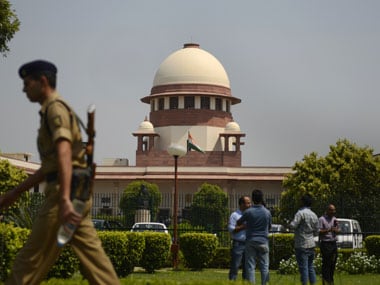
Supreme Court of India. AFP[/caption]The report was submitted to a bench of Justice Dipak Mishra, Justice Ashok Bhushan and Justice Bhanumati on Friday.Ramachandran listed six fundamental errors committed by the trial court while awarding death sentences, reported The Hindu. He argued that the circumstances of all the accused were not considered before sentencing and neither were they heard in person about their punishment.The report submitted by Ramachandran states that since a fair trial was denied to the accused, the death sentence violated Articles 14 and 21 of the Constitution. The order for the sentence was passed by the trial court on 11 September, 2013 and confirmed by the High Court.His writ submission also argued that the reasons for the imposition of death penalty on each of the accused were not given separately and a 'one-penalty-fits-all' order was imposedAccording to Bar & Bench, Ramachandran has not challenged the death penalty awarded to the convicts but rather, he has challenged the sentencing order itself. He was assisted by advocate K Parameshwar.Parameshwar told CNN-News18, "After a conviction, before a sentencing is pronounced, the convict must be given a chance to state any mitigating factors which could help the court avoid imposition of the death sentence.” He also said that the curt has itself said that factors like socio-economic conditions of the accused, mental health and other parameters could be highlighted by the accused before a sentencing is pronounced.However, while upholding the death sentences of four of the six accused, the Delhi High Court had observed that “exemplary punishment” was the need of the hour.Part I of the submission highlighted the mitigating factors. Part II of the submission would be made on Friday to the bench and it would involve how the courts failed to strike a proper balance between “the aggravating and mitigating factors while pronouncing the death sentence,” Parameshwar said.Ramachandran relied on the Bachan Singh v. State of Punjab case, according to the Bar & Bench report, and quoted section 235(2) and 354(3).Section 235 (2) imposes a duty on the judge , unless he proceeds in accordance with the provisions of section 360, to hear the accused on the question of sentence, and then pass sentence on him in accordance with law. Section 354 (3) mandates that when the conviction is for an offence punishable with death or, in the alternative, with imprisonment for life or imprisonment for a term of years, the judgment shall state the reasons for the sentence awarded, and, in the case of sentence of death, the special reasons for such sentence.Both these sections were violated by the court while sentencing the accused in the December 2012 gangrape case, Ramachandran said.Justice Markandey Katju dismissed the report submitted by Ramachandran and said that there was no question of looking at mitigating factors in the 16 December case because of the gravity of the crime committed.

India successfully tests long-range 'Kusha' air defence missile system
Indian trucker arrested in US over alleged theft of $3 million worth of tungsten powder
China has dominated Myanmar’s rare earth mines — now India eyes deal to harness country’s critical minerals
CJP protest in Delhi: New videos of stone pelting, violence emerge as police, agitators trade charges
'From make in India to launch from India': Skyroot COO on why Vikram-1 could change India’s space sector