
Advertisement


Sections
How to master Virat Kohli’s one-arm push-up
The one-arm push-up is one of the most beneficial bodyweight exercises. They strengthen your arms, shoulders, chest, core, legs and hips.

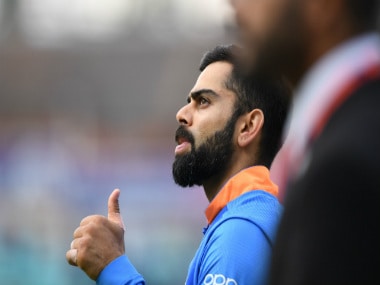
If you have any interest in fitness, you couldn’t have missed the challenge skipper Virat Kohli posted on Twitter for all his fans. In the video, Virat performed a one-arm push-up and asked his fans to try it too. There is no doubt that a one-arm push-up is not the easiest bodyweight exercise, but it is definitely one of the most beneficial ones. They strengthen your arms, shoulders, chest, core, legs, and hips.This exercise involves a lot of strength, balance, and practice. If you’re not as fit as Virat Kohli (and to be honest, how many of us can really say that we are?), you need to prepare your body for this unilateral body-strengthening exercise.Let’s have a look at the five progressions that will help you to master the one-arm push-up:[caption id="attachment_7495621" align="alignleft" width="380"]![Representational image. Image source: Getty Images.]() Representational image. Image source: Getty Images.[/caption]
Representational image. Image source: Getty Images.[/caption]
 Representational image. Image source: Getty Images.[/caption]
1. Bent-knee push-up
- Lie down on your stomach on a mat. Place your palms on the mat, right beside your shoulders.
- Keeping your knees on the mat, push yourself up until your arms are straight. Make sure your body is in one line, from the top of your head down to your knees.
- Maintain shoulder-width space between your hands.
- Keep your heels together and your glutes squeezed.
- Slowly lower your body by bending your arms at the elbows until your chest or chin touch the floor. Keep your torso rigid.
- Come back to the starting position by fully extending your arms. Repeat at least eight times.
2. Second progression
- Begin in the bent-knee push-up position but with your knees and legs straightened as well - this is the plank position.
- Press downwards to touch your chin or chest to the floor. Your elbows should stay close to your body or extend outwards a little.
- Pause for a second and then gently drop your knees back to the mat. (This is a negative push-up - putting pressure only while going down)
- Extend your arms to push upwards. Return to the starting position by straightening your knees and legs, and then repeat at least eight times.
3. Standard push-ups
- Begin in the plank position. Tense the entire body.
- Keep your neck in line with your spine. Check that your hips are neither raised nor slumped - your body should be in a straight line from head to toe.
- Press downwards by bending the elbows and touching the floor with your chest.
- Don’t relax your muscles and push upwards by fully extending your arms.
- Repeat at least eight times.
4. Bent-knee archer
- Begin in the bent-knee push-up position but with your legs slightly wider than the hip-width. Keep your knees bent and your toes in touch with the ground.
- Keep the left arm (assessing arm) close to the body and the right arm (assisting arm) stretched out parallel to the floor.
- Press down to the floor while bending your left arm. Keep the right arm stretched out for balance.
- Push upwards off the ground without taking rest or losing tension in your body.
- Repeat eight times, switch arms and then repeat eight more times.
5. Full-archer push-up
- The set-up will be the same as the bent-knee archer but keep your legs and knees straightened. This will increase the pressure on the arm that is supporting your weight (assessing arm).
- Keep the assessing arm close to the body and the assisting arm stretched out.
- Press down your whole body by bending the assessing arm. Try to touch your chest to the floor.
- Now push upwards. Reverse the movement by lifting the chest, hips, and knees without taking rest and losing tension in your body.
- Repeat eight times, switch assessing and assisting arms and then repeat eight more times.
Welcome to the single-arm push-up:
- Start in the regular plank position.
- Keep your feet wide apart, wider than the shoulders.
- Put the arm you want to do push-ups with directly under the centre of your chest. Keep your other arm behind your back.
- Keep your core tight as you press down your chest towards the floor.
- Push upwards while keeping your spine straight. That’s one rep.
First Published:Oct 14, 2019, 12:39:58 IST
Advertisement
Advertisement

10,000 steps a day is not enough: Top doctor explains the role of timing
Walking 10,000 steps a day is beneficial, but experts say timing matters. Short walks after meals and breaking up long periods of sitting may be more effective for blood sugar control and overall metabolic health
3 min read
What happens when you stop drinking tea for 30 days? Doctor explains the effects
Thinking of quitting tea for a month? Experts explain how cutting out caffeine can affect your body, from withdrawal symptoms in the first week to better sleep and improved iron absorption over time.
2 min read
Stroke is rising among young adults. Doctor explains why it's happening and what you must do
Stroke is increasingly affecting adults in their 30s, 40s and 50s. Experts say unhealthy lifestyles, undiagnosed high blood pressure and delayed treatment are driving the rise in younger stroke cases
3 min read
Stroke in young adults, silent symptoms and late diagnosis: India's growing brain health challenge
Neurologists warn that stroke is increasingly affecting people in their 30s and 40s, while many brain disorders progress silently before symptoms appear. They say early diagnosis, timely referrals and healthier lifestyles are key to reducing India's growing neurological disease burden.
5 min read
Brain tumours aren't always fatal, but delayed diagnosis can be: Experts explain the key warning signs
Brain tumours are frequently mistaken for common headaches, stress or age-related cognitive changes. Doctors say recognising warning signs early and adopting a brain-healthy lifestyle can improve outcomes and reduce the risk of long-term neurological complications.
2 min read
Advertisement
Advertisement