


Coronavirus Outbreak: Policy opportunity knocks for govt in migrant crisis; time's right to think smart districts
One of the unintended and unpleasant consequences of the 21-day coronavirus lockdown has been tidal reverse migration from the big cities like Delhi, Mumbai, Ahmedabad and Bangalore to mainly Bihar and Uttar Pradesh

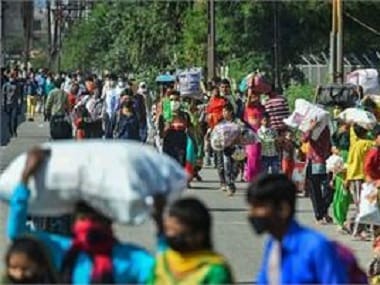
Representational Image. PTI[/caption]First, it would decongest our over-crowded cities. According to the 2011 Census, around 10 million of the combined 30 million population of Delhi and Mumbai comprises migrants. Imagine a couple of million from each city deciding to settle down in their home districts with gainful employment; a couple of million less vying for a metropolis' health, housing, commuting, water, electricity and a range of services.Second, homing pigeons with urban skillsets and work culture can be transformative for the economy of villages, census towns and semi-urban centres. Reverse migrants could spawn a clutch of jobs and enterprise from laundry to delivery services to grocery to smart beauty parlours in highly aspirational small towns. Local administrations just have to extend a helping hand.Third, it would hasten India's shift from the labour-intensive, low-return agricultural economy to the revenue-intensive service sector.NITI Aayog, along with state governments, has already embarked on a development roadmap for 117 'aspirational districts' across the country. These used to be the laggards both in terms of social and economic indices.The districts range from Dahod in Gujarat to Khagaria in Bihar to Ribhoi in Meghalaya. Each district is now tracked and ranked on parameters like health and education, agriculture, financial inclusion, skill development and basic infrastructure, spurring healthy competition.A state like Bihar can extend the same model of development to more districts so that the men from Motihari don't have to come to Delhi or Mumbai to drive autos and face the anger of locals eyeing the same jobs.Another way to invigorate district economies is to identify and develop specific advantages of each district. The Uttar Pradesh government has walked a few steps in that direction with its 'One District One Product' initiative. As part of it, a unique speciality of a district is identified and developed as a local industry, connecting it to national and international markets. Whether it is wood carvings of Saharanpur, zari-zardozi of Kasganj, shoes of Hamirpur or wheat stalk handicraft of Bahraich, connecting the reverse migrants to some of these initiatives could make them never want to leave home for an uncertain livelihood in a distant land again.Lastly, the direct cash transfers that first the Yogi Adityanath government and now the Centre have initiated can not only help them tide over the immediate trouble, but in future provide confidence and seed money to start something in their hometown.In this dire human suffering lies both hope and scope.Smart cities may need more time to take shape, but governments can start working towards smart districts, smart towns and smart villages.

Stroke is rising among young adults. Doctor explains why it's happening and what you must do
Stroke in young adults, silent symptoms and late diagnosis: India's growing brain health challenge
Brain tumours aren't always fatal, but delayed diagnosis can be: Experts explain the key warning signs
Spices, health and the Indian plate: Why chilli can be good for you—but moderation is still key
Organ donation: 5 myths you need to stop believing, according to a transplant specialist