
Advertisement


Sections
Why Tel Aviv police chief’s resignation led to protests across Israel
Thousands of protesters hit the streets in Israel on Wednesday (5 July) after Tel Aviv police chief Amichai Eshed announced his resignation from the force, citing his refusal to heed the demand by the far-right Cabinet to take a tougher stance against anti-government protests

Thousands of protesters hit the streets across Israel on Wednesday (5 July) after the "forced" resignation of Tel Aviv's police chief. With chants of "democracy", several demonstrators carrying blue and white Israeli flags marched through Tel Aviv, blocking its main highway.As per The Times of Israel, protesters also gathered at Paris Square in Jerusalem. Some were also seen outside Prime Minister Benjamin Netanyahu’s official residence on Jerusalem’s Azza Street, leading to clashes with the police.What happened at these protests and what made Tel Aviv's police commander quit the force? We explain.Protests grip IsraelProtesters in thousands blocked Tel Aviv’s Ayalon Highway for several hours, bringing the traffic to a halt. They blew horns, danced in the street as well as lit bonfires, reported Associated Press (AP).The police mounted on horseback tried to disperse the demonstrators using a water cannon. The residents in nearby buildings burst firecrackers to show solidarity with the protesters, according to The Times of Israel report.Many videos shared on social media showed the police thrashing protesters who refused to vacate the highway. At least 15 protesters were arrested by the police from the Ayalon, the report added.[caption id="attachment_12836672" align="alignnone" width="640"]![israel protests]() Demonstrations were held in 40 locations across Israel on 5 July. AP[/caption]In Jerusalem’s Paris Square, the police fired “foul-smelling” water from the cannons to push back the crowds amid cries of “Shame”, The Times of Israel reported.Demonstrations were held in 40 locations, including the Karkur, Carmiel, Tzemach, Horev, Rager and Azza intersections in northern and southern Israel.These protests evoked memories of mass protests that hit the country in March this year when Netanyahu tried to fire Defence Minister Yoav Gallant for challenging the government’s controversial plan to overhaul the nation’s legal system. Following large-scale protests, the prime minister later shelved his decision to axe Gallant.ALSO READ: Israel witnesses ‘biggest’ protest in history: What has angered the public?Why did the Tel Aviv police chief resign?The Wednesday night protests were sparked after Tel Aviv police chief Amichai Eshed announced he was quitting the force, citing differences with members of Netanyahu's hard-right Cabinet on the use of excessive force against anti-government protesters, reported Reuters.As per The Times of Israel, Eshed was to be sacked from his post and shifted to a marginal role. In a press conference, the now-former Tel Aviv police chief lamented the “terrible [personal] cost for my choice to prevent civil war.”“I could have easily used disproportionate force and filled the Ichilov [a hospital in Tel Aviv] emergency room at the end of every demonstration in Tel Aviv. We could have cleared Ayalon [Highway] within minutes at the terrible cost of cracking heads and breaking bones and at the cost of breaking the pact between police and the citizenry,” Eshed said.[caption id="attachment_12836682" align="alignnone" width="640"]
Demonstrations were held in 40 locations across Israel on 5 July. AP[/caption]In Jerusalem’s Paris Square, the police fired “foul-smelling” water from the cannons to push back the crowds amid cries of “Shame”, The Times of Israel reported.Demonstrations were held in 40 locations, including the Karkur, Carmiel, Tzemach, Horev, Rager and Azza intersections in northern and southern Israel.These protests evoked memories of mass protests that hit the country in March this year when Netanyahu tried to fire Defence Minister Yoav Gallant for challenging the government’s controversial plan to overhaul the nation’s legal system. Following large-scale protests, the prime minister later shelved his decision to axe Gallant.ALSO READ: Israel witnesses ‘biggest’ protest in history: What has angered the public?Why did the Tel Aviv police chief resign?The Wednesday night protests were sparked after Tel Aviv police chief Amichai Eshed announced he was quitting the force, citing differences with members of Netanyahu's hard-right Cabinet on the use of excessive force against anti-government protesters, reported Reuters.As per The Times of Israel, Eshed was to be sacked from his post and shifted to a marginal role. In a press conference, the now-former Tel Aviv police chief lamented the “terrible [personal] cost for my choice to prevent civil war.”“I could have easily used disproportionate force and filled the Ichilov [a hospital in Tel Aviv] emergency room at the end of every demonstration in Tel Aviv. We could have cleared Ayalon [Highway] within minutes at the terrible cost of cracking heads and breaking bones and at the cost of breaking the pact between police and the citizenry,” Eshed said.[caption id="attachment_12836682" align="alignnone" width="640"]![israel protests]() Israel has been witnessing weekly protests since January against the government’s proposed judicial overhaul. AP[/caption]"For the first time in three decades of service, I encountered an absurd reality in which ensuring calm and order was not what was required of me but precisely the opposite," he said, as per Reuters, in a televised statement announcing his resignation.
Israel has been witnessing weekly protests since January against the government’s proposed judicial overhaul. AP[/caption]"For the first time in three decades of service, I encountered an absurd reality in which ensuring calm and order was not what was required of me but precisely the opposite," he said, as per Reuters, in a televised statement announcing his resignation.
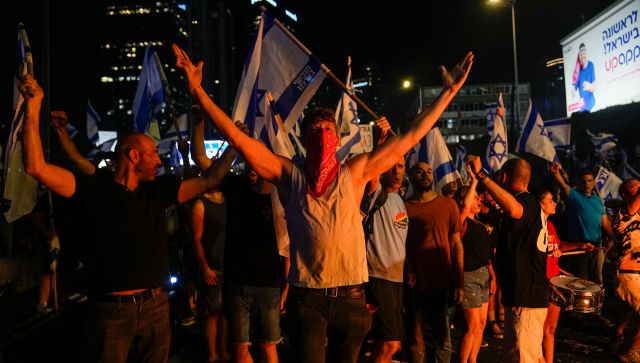 Demonstrations were held in 40 locations across Israel on 5 July. AP[/caption]In Jerusalem’s Paris Square, the police fired “foul-smelling” water from the cannons to push back the crowds amid cries of “Shame”, The Times of Israel reported.Demonstrations were held in 40 locations, including the Karkur, Carmiel, Tzemach, Horev, Rager and Azza intersections in northern and southern Israel.These protests evoked memories of mass protests that hit the country in March this year when Netanyahu tried to fire Defence Minister Yoav Gallant for challenging the government’s controversial plan to overhaul the nation’s legal system. Following large-scale protests, the prime minister later shelved his decision to axe Gallant.ALSO READ: Israel witnesses ‘biggest’ protest in history: What has angered the public?Why did the Tel Aviv police chief resign?The Wednesday night protests were sparked after Tel Aviv police chief Amichai Eshed announced he was quitting the force, citing differences with members of Netanyahu's hard-right Cabinet on the use of excessive force against anti-government protesters, reported Reuters.As per The Times of Israel, Eshed was to be sacked from his post and shifted to a marginal role. In a press conference, the now-former Tel Aviv police chief lamented the “terrible [personal] cost for my choice to prevent civil war.”“I could have easily used disproportionate force and filled the Ichilov [a hospital in Tel Aviv] emergency room at the end of every demonstration in Tel Aviv. We could have cleared Ayalon [Highway] within minutes at the terrible cost of cracking heads and breaking bones and at the cost of breaking the pact between police and the citizenry,” Eshed said.[caption id="attachment_12836682" align="alignnone" width="640"]
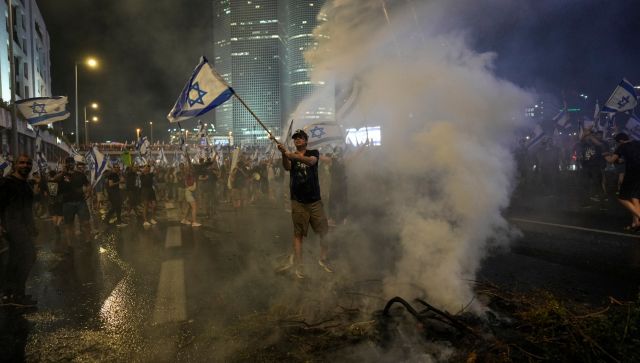 Israel has been witnessing weekly protests since January against the government’s proposed judicial overhaul. AP[/caption]"For the first time in three decades of service, I encountered an absurd reality in which ensuring calm and order was not what was required of me but precisely the opposite," he said, as per Reuters, in a televised statement announcing his resignation.
Israel has been witnessing weekly protests since early January this year against the Netanyahu government’s proposed judicial overhaul.Eshed claimed his refusal to heed the demand for tougher action against anti-government protests led to “a well-oiled poison machine turning against me online, leading to significant threats to my life and to my designation as being under the highest level of threat. But this did not dissuade me. At all times I saw before me one roadmap, one compass: checks and balances, the Israeli law and the rules of morality and justice”, reported The Times of Israel.ALSO READ: Why Israel launched an attack on West Bank’s JeninWhile Eshed did not name National Security Minister Itamar Ben-Gvir, who oversees the police, it is believed the police officer resigned due to the far-right politician. The duo has clashed several times in the past, with Ben-Gvir demanding a tougher crackdown on the protesters and Eshed refusing to comply.In March, Ben-Gvir had demoted Eshed to the head of the police training department for being, according to him, lenient with anti-government protesters. However, his order was put on hold by Attorney-General Gali Baharav-Miara, who called the transfer “politically motivated”, reported The Times of Israel.Following Eshed’s announcement to resign, Ben-Gvir, the far-right Otzma Yehudit lawmaker, accused the police officer of “surrendering to the left.”"Politics has seeped into the most senior ranks in Israel and a uniformed officer has caved to senior politicians on the left," the minister was quoted as saying by Reuters.Later, he also took a dig at Eshed in a tweet: “The words of Ami Eshed tonight prove that a political superintendent served in uniform in the Israel police. I wish him great success in his future as a candidate in the next elections in the left party.”With inputs from agencies
First Published:Jul 06, 2023, 20:10:28 IST
Advertisement
Advertisement

How a 27-year-old woman broke the internet during Mumbai's CJP protests
Rhiya Ahir blocked a police van by standing in front of it during the CJP protests, gaining instant fame for her defiant stance. The 27-year-old is model, actor and digital content creator, and comes from a defence family
3 min read
The Great Covid Fraud: How Indian-origin couple in UK funded lavish lifestyle through fake PPE orders
Indian-origin couple Jogesh Bhandari and his wife Meenakashi Bhandari have bee convicted of carrying out a personal protective equipment (PPE) scam alongside associate Craig Morris in the United Kingdom. The investigation found bank records showing Bhandari and his wife used the money to purchase Rolex watches, jewellery, holiday packages and luxury cars
3 min read
Fake jobs, tourist visas: Inside Russia’s vast network luring foreigners to fight Ukraine war
Russia is accused of using fake job offers, tourist visas and lucrative military contracts to recruit thousands of foreign nationals for the Ukraine war. Investigations reveal how poverty, deception and coercion have drawn people from Asia, Africa and Latin America into one of the world's deadliest conflicts
8 min read
Why has Bangladesh’s choice of India spokespersons raised eyebrows?
Bangladesh’s appointment of journalists Md Saidur Rahman and Umme Marufa to media roles in New Delhi and Kolkata has triggered controversy over their past anti-India social media posts, many of which were later deleted, prompting diplomatic scrutiny as India and Bangladesh seek to improve bilateral ties
6 min read
Who is Sandeep Lamba, the Delhi cop removed from protest site duty after slapping female protester?
Sandeep Lamba, an Additional Deputy Commissioner of Police (DCP) (North East District), was seen slapping a female CJP protester in a video on July 20. Lamba has now been removed from the protest site and sent back to his original station. In 2021, Lamba was awarded the Union Home Minister’s medal for excellent investigation
4 min read
Advertisement
Advertisement