


Neet vs Gaokao: How the Chinese embassy is mocking India’s exam fiasco
Every year, millions of Chinese students appear for the national university entrance exam — ‘Gaokao’, considered one of the toughest in the world. After China recently completed the tests, the Chinese embassy spokesperson in India compared the national exam with JEE and Neet, pointing out how the Asian country came together to ensure Gaokao was ‘conducted smoothly’

Millions of students in China sat for one of the world’s toughest exams recently. The “Gaokao”, China’s national exam, brought cities across the country to a virtual halt for two days.
On Wednesday (June 10), the Chinese embassy spokesperson in India, Yu Jing, took a subtle dig at India by comparing the competitive exams of both countries, saying that the Chinese equivalent of JEE/Neet, Gaokao, was “conducted smoothly”.
“China’s Gaokao — the world’s largest exam & India’s equivalent of JEE/NEET rolled into one — was conducted smoothly for 1.3 crore students in just 2 days,” Yu wrote on X.
“Factories paused. Roads quieted. The entire nation rallied for its students,” she added.
Her remarks come at a time when Neet aspirants are preparing for a re-test after the National Testing Agency (NTA), which administers the exam, cancelled the test in May following allegations that the question paper had been leaked before the examination. The alleged irregularities in Neet-UG 2026 have stirred a massive uproar in India.
 More from Explainers
But what is China’s Gaokao, which brings the Asian giant to a standstill?
What is the Gaokao?
Every year, millions of students in China appear for the notoriously hard Gaokao. These national university entrance examination test high school passouts on their Chinese, mathematics, English and either science or humanities.
The exams are typically held every June and last about 10 hours over multiple days.
This year, around 12.9 million (1.29 crore) students across China registered for the gaokao, according to the Ministry of Education.
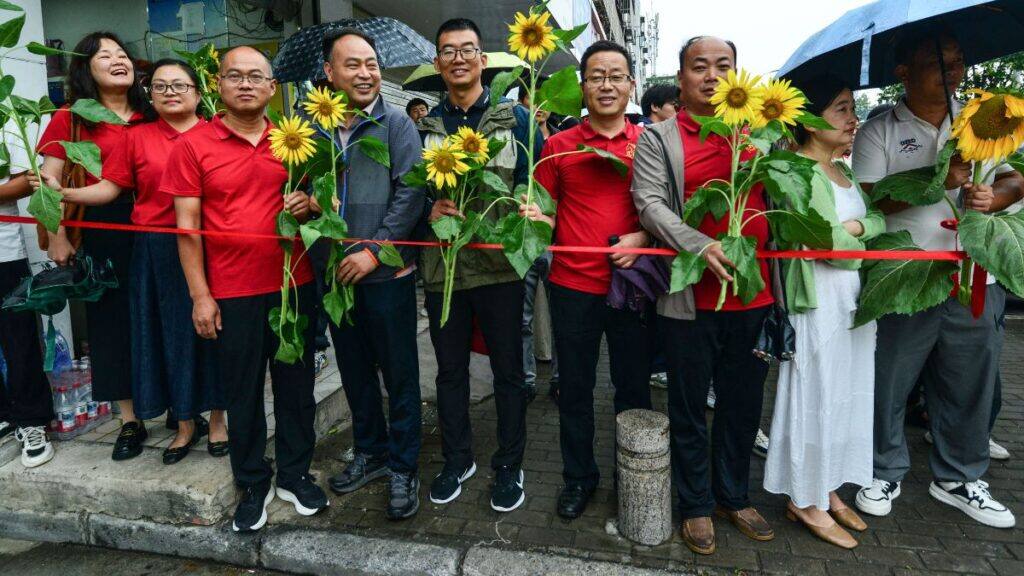
During exam days, parents line up outside test centres to show support to their children taking the undergraduate admission exam in China. They are often dressed in qipao dresses, which symbolise “victory from the start,” or hold sunflowers that represent “success in a single attempt,” as per a South China Morning Post (SCMP) report.
China makes extraordinary efforts to protect the exam papers from leaks. Teachers who prepare the exam questions are reportedly kept in secure facilities for roughly a month. The papers are printed at high-security units, including prisons, with close watch on waste disposal and drainage systems to prevent leaks.
The exam papers are transported by armed convoys that take designated routes using satellite tracking and live monitoring. Once papers reach the venue, they are placed in secure rooms with iron doors, barred windows and locked cabinets. Guards are deployed round-the-clock at these centres.
Those seeking to enter the rooms need to pass through three doors, each requiring a key held by different individuals, reported SCMP.
This year, students were explicitly warned against bringing smart glasses or smart watches into test centres that are under video surveillance.
Origin of Gaokao
The Gaokao traces its roots to imperial China.
The cultural ancestor of Gaokao is said to be keju, the imperial Chinese civil service examination system, believed to have originated during the Sui dynasty (581–618). These exams allowed the selection of officials through subject-based tests instead of just birth or recommendation, according to SCMP.
The system evolved over centuries until it was abolished in 1905 by the Qing government (1644–1912). By that time, keju had started looking increasingly obsolete and unfit to meet the needs of a modernising nation.
After 1905, modern schools began to spring up nationwide, with a focus on subjects such as mathematics, physics, and engineering. Specialised and vocational schools were also established with state support.
When the People’s Republic of China was founded in 1949, around 80 per cent of the population was estimated to be illiterate. Gaokao was introduced in 1952 to enhance educational standards in the Asian country, as per the SCMP report.
The Gaokao system was suspended during the Cultural Revolution in China, but was later reinstated in 1977. It has since become the focal point of the country’s education system.
Criticism of China’s rigorous exam culture
The frenzy around Gaokao is all-consuming in China. Failing these exams leaves one with nearly a lifetime of low-ranking employment, as well as family disappointment.
The massive pressure surrounding the exam has resulted in the mushrooming of Beijing’s after-school tutoring industry, which expanded to $100 billion before a government crackdown.
Despite China's tight security measures, the 2022 exam was riddled with cheating and paper leak concerns.
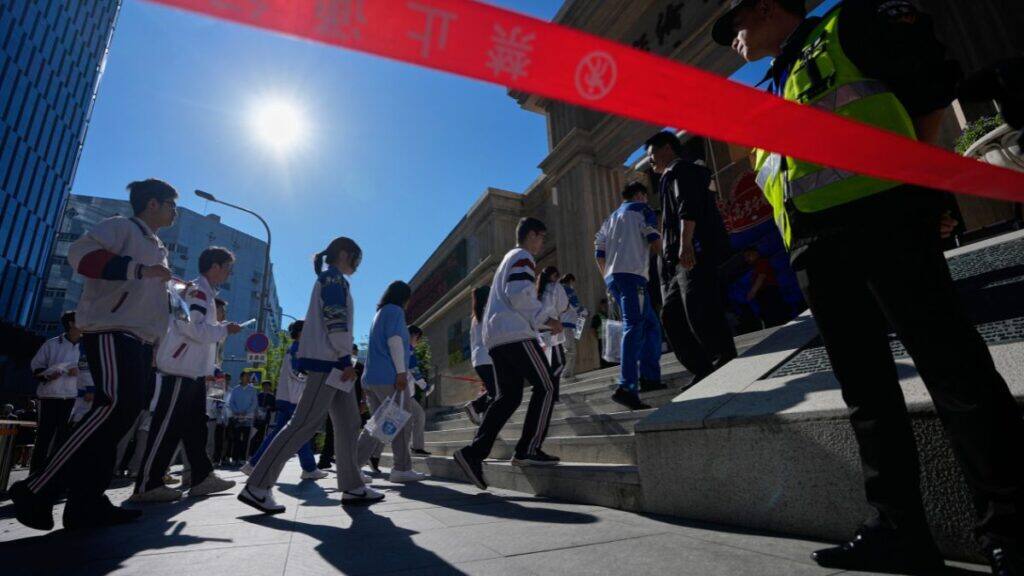
To study for one of the toughest exams in the world, Chinese students spend an average of 60 hours per week. Some even start skipping middle school classes and hire a private tutor to solely concentrate on their Gaokao exam.
The intense stress on students to pass these exams has also led to severe anxiety and depression. A 2025 China Daily report examined the mental impact of China’s two-day weekend policy for high school students ahead of Gaokao.
Sometimes, the pressure of achieving top scores has forced students to go to extreme lengths, including "use of IV drips, meant to help them concentrate while studying", "teenage girls taking contraceptives to delay their periods until after the test", and spending sleepless nights, according to SCMP.
China's youth appeared for the exams at a time when the country is grappling with high youth unemployment. Official data shows that nearly one in six Chinese between the ages of 16 and 24, excluding students, are jobless.
This puts forward a difficult scenario before the children: Despite years of academic pressure and parental expectations, where are the jobs?
With inputs from agencies
Tags

How a 27-year-old woman broke the internet during Mumbai's CJP protests
The Great Covid Fraud: How Indian-origin couple in UK funded lavish lifestyle through fake PPE orders
Fake jobs, tourist visas: Inside Russia’s vast network luring foreigners to fight Ukraine war
Why has Bangladesh’s choice of India spokespersons raised eyebrows?
Who is Sandeep Lamba, the Delhi cop removed from protest site duty after slapping female protester?