
Advertisement
Co Presented By
Co Presented By


Sections
Two years of Modi in 6 charts: Check out how the govt has fared
It bodes well for the country that the government has resorted for structural reforms rather than quick fixes to boost the economy

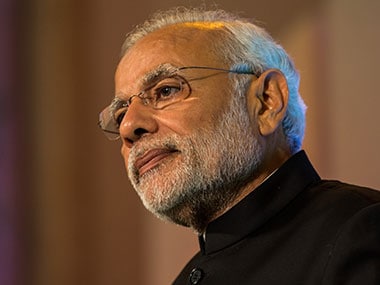 Prime Minister Narendra Modi. Getty Images[/caption]According to a report in the Business Standard on Thursday, in a poll as many as 50 CEOs have expressed satisfaction over the reforms steps taken by the government. They have given a rating of 7 out of 10 for the government.But what is the situation on the ground?Here are 6 graphics that will help you understand:GDP: In the third quarter of 2014-15, the year Modi came to power, the GDP grew 6.5 percent. The figure has held above 7 percent consistently after that. However, there are doubts about this figure as many believe the higher print was mainly owing to a change affected in the methodolgy of calculating the GDP. They ask: If the country is indeed the fastest growing, what about the high bank NPAs, weak corporate earnings and distressed rural economy?
However, as Modi's third year kicks in, there is a bit of good news on this front. "The bad news is that we believe economic growth has been overestimated in the last few quarters. The good news is that, first, this is likely to be temporary - the data will become more accurate as prices normalise over the next six quarters," Pranjul Bhandari, India economist, HSBC, said in a recent article in Business Standard. She also added that there could be an auto correction in the GDP figures going forward and this may not necessarily mean "renwed weakness in the economy at the ground level".Inflation: Inflation seems to have been tamed over the last few months as retail prices stood at 4.83 percent in March 2016. The key reason for this is the fall in global prices of commodities, including the crude oil. But now there are fresh fears that it may not be all that rosy as there is a sharp increase in food inflation owing to the drought condition prevailing in many parts of the country. The prices of food items are likely to rise further, experts feel."We expect another month or two of firming up of prices. It would be therefore be very critical to make assessment of the monsoon arrival and its performance thereafter," Shubhada Rao, Chief Economist, YES Bank, told Reuters after the release of the April inflation data.
What is likely to add to the worries is the rising oil prices. According to Citigroup, the prices, now nearing $50 a barrel, have "turned a corner" and are likely to average around $47 a barrel this year, which is $4 higher than its previous estimate.IIP: A look at industrial output data shows that there is indeed reason to worry. The IIP in March witnessed a decline of 0.1 percent. The data, which has witnessed wide fluctuations historically, signifies that the industrial recovery is wobbly. "Looks like same old story of rural demand being weak, investment demand being weak. So consumer non-durable and cap goods are basically the ones where there has been a contraction. Consumer durables, which signifies urban discretionary demand continues to do relatively well. So, basically no sign yet of the industrial recovery actually broadening out," Nomura economist Sonal Varma said commenting on the IIP data for March.
There are other data sets that raise doubts about the industrial recovery. New capex investments that stood at Rs 4.06 lakh crore in third quarter of 2014-15 has declined sharply to just Rs 1.05 lakh crore in third quarter of 2015-16. The key reason for this is the fall in public investment from Rs 2.05 lakh crore to just Rs 36,000 crore during the period.
Another data is the stalled projects, which are also on the rise. In the first quarter of 2015-16, the amount of such projects had fallen marginally to Rs 9.3 lakh crore from Rs 9.6 lakh crore in the second quarter of 2014-15. This has seen a steady increase to Rs 11.4 lakh crore in the fourth quarter of 2015-16, indicating a funding crunch. Banks are not lending as they are straddled with high NPAs (11 percent of their loan book). And with no sign of abatement in bad loans as yet, there is unlikely to be a faster recovery.
Jobs: Have jobs turned out to be the biggest disappointment for Modi? It seems so when you look at the labour bureau data. As per the available data, as of December 2015 not only that there were no new jobs created but there was a decline of 20,000 jobs across eight labour intensive sectors in the December quarter of 2015.
So is this going to change? A recent Teamlease Employment Outlook Report said e-commerce and tech startups are likely to dominate hiring landscape in the coming months. Recruitments in the manufacturing & engineering and infrastructure sectors is unlikely to see any pick up due to the negative sentiment created by the slow progress of Make in India initiative, it said.All in all, the data points discussed above are not painting that rosy a picture about the economy.However, many are of the opinion that the policy initiatives taken have resulted in a number of positives.As Anis Chakravarty, Lead Economist & Senior Director, Deloitte India, notes structural macroeconomic change takes time to have an impact."It bodes well for the country that the government has resorted for structural reforms rather than quick fixes to boost the economy. Overall, I expect the government’s focus on reforms to bring in change for sustainable growth," he says.Data by Kishor Kadam
First Published:May 26, 2016, 14:45:24 IST
Advertisement
Advertisement

EU slaps Google with $1 billion antitrust fine over Play Store and Search practices
European Commission says Google unfairly favoured its own services on Search and the Play Store, violating the Digital Markets Act; the company calls the decision harmful to businesses and consumers.
1 min read
Brent crude flirts with $100, reigniting inflation and forex concerns for India
Experts say a prolonged rally above $100 per barrel is unlikely, but sustained high oil prices could push up inflation, widen the current account deficit and pressure the rupee.
2 min read
Can a record May offset a shrunk international schedule and help IndiGo turn a profit?
Record domestic market share boosts operating performance, but forex losses, rising oil prices and geopolitical disruptions could weigh on IndiGo's bottom line.
3 min read
China has dominated Myanmar’s rare earth mines — now India eyes deal to harness country’s critical minerals
India is deepening rare earth cooperation with Myanmar as New Delhi seeks alternative sources of critical minerals dominated by China, including dysprosium and terbium used in EVs, defence systems and clean energy technologies
6 min read
JPMorgan to hire 1,000 technology professionals for India GCCs amid AI-led transformation
Wall Street banking giant to expand hiring across cloud, cybersecurity and AI data pipeline roles as it strengthens its India Global Capability Centres despite AI-driven workforce optimisation.
1 min read
Advertisement
Advertisement