



Forget eNAM, to create single agri market Modi must first tackle politically powerful APMCs
Unless the state governments amend their respective APMC Acts, eNAM will fail to create to a single market for farm produce

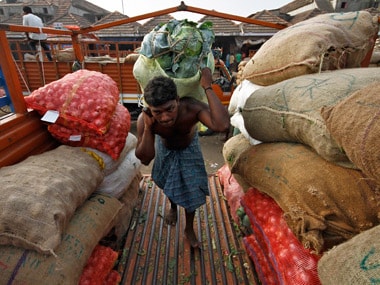
Representational image. Reuters[/caption]Why is this important?The move is part of implementation of the roadmap for doubling income of the farmers by 2022, announced by Modi, about which experts have already raised doubts. In July last year, the Cabinet had approved setting up of an online national agriculture market with a budget of Rs 200 crore.At present, farmers are restricted to selling produce at mandis that charge various taxes. The online agri-market is expected to give choice to farmers to sell their produce both in physical mandis or online platform. The easy access to sell online trade is likely to boost their incomes and improve availability, moderating price rise, agriculture minister Radha Mohan Singh had earlier claimed.Despite the e-platform, why single market for farm produce is unlikely to be established anytime soon?The big challenge to the plan aimed at creating a single market for farm products is going to be the APMC Act, the law that at present governs the farm produce market. The Act was passed in 1950s with the objective of bringing transparency in the agriculture markets and protecting farmers from exploitation by the moneylenders and middlemen.Since agriculture is a state subject, state governments enacted separate APMC Acts. The Act, however, turned out to be counter productive since the Agriculture Produce Marketing Committees themselves metamorphosed into middlemen and became severely restrictive for the farmers as it took away their freedom to sell whomever they wanted to.Highlighting the problem of APMCS, Economic Survey 2014-15 had said, "One of the most striking problems is how unintegrated and distortions-ridden are our agricultural markets. India needs a national common market for agricultural commodities by making the Agricultural Produce Market Committees (APMCs) just one among many options available for the farmers to sell their produce."It further said that "APMCs levy multiple fees of substantial magniture that are non-transparent and hence a source of political power". It also noted that "these Acts created fragment markets for agricultural commodities and curtailed the freedom of farmers to sell their produce other than through the commission agents and other functionaries licensed by the APMCs".So without the states amending their APMC Acts creating a single agriculture market will be difficult. A report in Mint said only three states - Madhya Pradesh, Andhra Pradesh and Karnataka - have amended their APMC Acts. For the eNAM to succeed, the NDA government will have to take all the state governments on board and persuade them to amend APMC Acts and also devise laws to facilitate online trading of farm produce. Given the political power the APMCs enjoy, it is likely to be a long fight.With inputs from agencies

Brent crude flirts with $100, reigniting inflation and forex concerns for India
Can a record May offset a shrunk international schedule and help IndiGo turn a profit?
China has dominated Myanmar’s rare earth mines — now India eyes deal to harness country’s critical minerals
JPMorgan to hire 1,000 technology professionals for India GCCs amid AI-led transformation
BOJ seen raising interest rates by December as weak yen fuels inflation risks