



Replacing NITI Aayog with Planning Commission will not serve any purpose, both add very little value
If one looks at the web site of the NITI Aayog and counts the number in the directory, it is well over 500 with various classes of employees including support staff.

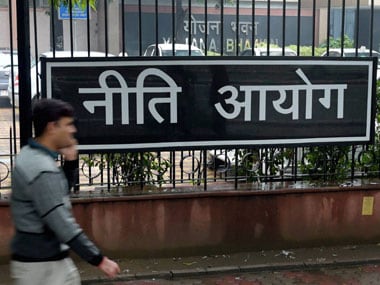
Representational image. PTI[/caption]The Planning Commission per se was an institution that was created when we had followed a mixed economy system in 1951 where the public sector had a very important role to play. It drew up elaborate strategies running into hundreds of pages on each sector and then advised the government on what could be done. The Five-Year Plan concept came into being where the document would talk of the funding required and the supply of the same.There would be sections on public sector outlays and the balance from the private sector which was beyond its jurisdiction. Hence, while it would say that Rs x crore was required for getting growth of 8 percent per annum over 5 years, the funding for the public sector would be the one elaborated while the private sector’s role would only be stated and not discussed.With the concept of planning becoming outdated once we embarked on reforms and the private sector became more dominant, it made sense to do away with the planning process and hence the Commission. The institution had to be reinvented to keep it at congruence with the changing environment. This has made the reading of a Budget document easier as the earlier plan expenditure was related to the annual plan outlays which were being partly financed by the Budget.Often the reader had to struggle to figure out how this fitted with the rest of the document. But, as the Five-Year Plan was exhaustive the so-called off-budgetary borrowing, which is opaque today, was transparently disclosed.Given the background of these two institutions, should we close down the NITI Aayog and replace it with Planning Commission? This may not be in order as it will not serve any purpose. If it is believed that the institution has not fulfilled its objectives then there is a case for replacing the personnel with another set and clearly redefining the goals.
It has been alleged that the Aayog has become ‘political’ which is a delicate issue today as any view taken on any economic aspect is interpreted as being ‘for’ and ‘against’ the government and hence there is in a way little tolerance being shown on both sides. Any criticism of a policy is viewed as being anti-government while anything being said in favour of the government is ‘politically motivated’.It is true, however, that when the Planning Commission ruled, there were independent views being expressed which were not always in conformity with the government position. But this was accepted. Today, however, with a lot of media space available, every view is made political which does not get restricted to this institution but also others like the Reserve Bank of India (RBI) which is unfortunate. Ideally such an institution should be working in the background and only get into the media glare for reports that have to be made public.Having another body for the government can be defended on grounds of experts putting forward their views. This would be in addition to the PMEAC and chief economic advisor of the DEA. The question is, how lean should be this body as this is another concern expressed by the Opposition? The Planning Commission was criticised for being over-sized and the NITI Aayog was to be a lean organisation.If one looks at the website of the NITI Aayog and counts the number in the directory, it is well over 500 with various classes of employees including support staff. Therefore, there is resemblance with the existing bureaucratic structures in any government department. The erstwhile Planning Commission had more than 1,000 employees and hence this seems to be an improvement.
The question really is whether having another such institution makes sense given that there are already several government-backed independent institutions that are doing similar jobs in different fields. Also at the end of the day, the deliverables need to be defined and evaluated as to whether or not value is being added.The analogy can be taken to the private world where research must have a customer who benefits from this work considering that such output is non-commercial. This becomes important as various ministries also have such research departments or outsource the same to other government-managed institutions to get inputs.Hence, if a planning concept is now anachronistic and does not have a strong case for resurrection, the same question must be posed for the NITI Aayog which should be evaluated independently. That may be the logical way of going about this task and keeping it apolitical.(The writer is chief economist, CARE ratings)
Madan Sabnavis is Chief Economist at CARE Ratings.

Brent crude flirts with $100, reigniting inflation and forex concerns for India
Can a record May offset a shrunk international schedule and help IndiGo turn a profit?
China has dominated Myanmar’s rare earth mines — now India eyes deal to harness country’s critical minerals
JPMorgan to hire 1,000 technology professionals for India GCCs amid AI-led transformation
BOJ seen raising interest rates by December as weak yen fuels inflation risks