



Raghuram Rajan: Do not personalise RBI office, it will survive any governor
The Economist quoted him as saying while looking down, the ships sailing to nearby docks provide clues as to the buoyancy of foreign trade.

London: Reserve Bank of India (RBI) will survive any governor and it is important not to 'personalise this office', the outgoing Raghuram Rajan said days before his surprise announcement that he was not interested in a second term.[caption id="attachment_2713182" align="alignleft" width="380"]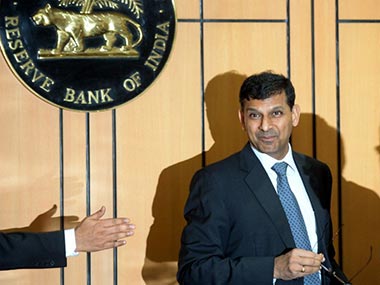 Raghuram Rajan. AFP[/caption]Rajan, a former International Monetary Fund (IMF) chief economist who is credited to have predicted the 2008 global financial crisis, has been often hailed as the ‘rockstar central banker’ ever since becoming RBI governor in September 2013 and for containing the rupee’s volatility amid global market uncertainties.Besides, he has also been often praised for containing inflation to a large extent and for forcing the banks to do a 'deep surgery' to clean up their books of bad loans.At the same time, he has also been criticised by some quarters for his hawkish monetary policy stance and refusing to heed to demands for lowering interest rates to boost the economy.“What is important is to not personalise this office. It will survive any governor, it is bigger than any governor,” the Economist magazine quoted Rajan as saying in its latest edition.The comments are believed to have been made amid intense speculation on whether he would get an extension or not as RBI governor—in the run-up to his own disclosure in a publicly- disseminated 'Message to RBI staff' that he would return to academia after the end of his current three-year tenure.“Though a relative newcomer to the cut and thrust of Indian policymaking, Rajan knows better than to offer any comment on his reappointment,” the magazine wrote.It said Rajan “need not even leave his office atop the Reserve Bank of India’s tower in Mumbai to gauge two factors central to India’s prosperity”.The Economist further quoted him as saying while looking down, the ships sailing to nearby docks provide clues as to the buoyancy of foreign trade. “The imposition of steel tariffs earlier this year, a knock-on effect from China’s slowdown, all but stopped traffic for a time”. It further said Rajan “favours incremental reforms over wholesale ones. He has made it easier to move money in and out of India, but not abolished capital controls in the way you might have expected from a former IMF chief economist”.According to the magazine, Rajan’s three-year term is the shortest of any G20 country and the recent governors have been given second terms as much as seven months in advance.In a separate article in its web edition after Rajan announced his decision against a second term, theEconomist called it “one of India’s favourite parlour games” coming to an end, while adding that a clean-up of the banking system that he initiated upset “India’s powerful—and indebted—industrialists”.

Google burns cash for first time as AI spending pushes 2026 capex to $205 billion
Tesla sells more cars but makes less money: Why Musk’s AI pivot is squeezing profits
No premium queues, 30-minute target: What changes for Indian passport applicants in UAE
Bharat Forge, Flying Whales sign pact to develop 60-tonne airships for India’s defence logistics
Air India to cut Delhi-Toronto flight time by 3 hours, resume non-stop services from August 1