
Advertisement
Co Presented By
Co Presented By


Sections
Policy flip-flop on e-commerce: Preferential pricing to gain some market share has to be stopped in its tracks
The government's recent flip-flop on opening of e-commerce to the so-called “non-essential” goods is just one of the many such flip-flops that the Government of India has made in the last 15 years on policies relating to modernisation of India’s retail sector

Despite the expected sharp slowdown of India’s economy in March, it may have still clocked a GDP of about $ 3,000 billion for the year ending on 31 March 2020. Private consumption accounts for about 58 percent of the GDP (expected to be about $1,700 billion). Of this, about 48 percent (or about $825 billion) is the consumer spending on merchandise (and therefore the size of India’s retail sector) and the remaining $875 billion is spent on a range of services (and small savings).Traditional, independent retail accounts for the largest share and will continue to do so for many years to come, despite the Cassandras shrill noises since the last 15 years about the potential decimation of the “mom and pop” retail stores by large format organised retail (both physical & digital).![ECOMMERCE GRAPH Final]() There are an estimated 17 million independent retailers (though some estimate this number to be closer to 30 million), and despite the relatively faster growth of modern, organised retail (brick and e-commerce-led), this number is still likely to increase to 20 (or more) million by 2025.In the backdrop of these facts, the shrill noise being made (since early 2000’s) by some quarters purporting to represent the interest of traditional “mom & pop” retailers and successive government's paying heed to such noises defies logic.The recent flip-flop on opening of e-commerce to the so-called “non-essential” goods is just one of the many that the Government of India has made in the last 15 years on policies relating to modernisation of India’s retail sector. However, the most recent one is perhaps the oddest one in current circumstances.
There are an estimated 17 million independent retailers (though some estimate this number to be closer to 30 million), and despite the relatively faster growth of modern, organised retail (brick and e-commerce-led), this number is still likely to increase to 20 (or more) million by 2025.In the backdrop of these facts, the shrill noise being made (since early 2000’s) by some quarters purporting to represent the interest of traditional “mom & pop” retailers and successive government's paying heed to such noises defies logic.The recent flip-flop on opening of e-commerce to the so-called “non-essential” goods is just one of the many that the Government of India has made in the last 15 years on policies relating to modernisation of India’s retail sector. However, the most recent one is perhaps the oddest one in current circumstances.![ECOMMERCEThinkstock_SM]() Going ahead, it is indeed necessary that the government should come up with clear rules and a clear intent to enforce the rules governing the operations of various e-retail businesses (and especially the marketplaces). Predatory / disruptive / preferential pricing, if undertaken to gain some market share, has to be stopped in its tracks so that all sellers on the marketplaces get a fair access to consumers.Further, the government should encourage more national and international marketplace businesses so that competition can bring the commissions being charged by the marketplaces from the sellers and ensure it is fair to both the seller and the marketplace operator.In this context, the government should also consider creating (as a government-promoted but independently managed entity) a consumer-facing version of a marketplace, on the lines of Government’s e-Marketplace (GeM) with India Post becoming the logistics partner. On such a 'public utility' (and e-market places should be considered as a necessary public utility of our times), preference could be given to MSME manufacturers and sellers of all kinds of consumer products, with commissions aligned to the objective to delivering some profit to this entity that can cover the cost of capital put into creating and running such an entity.(The writer is Chairman and Managing Director of Technopak Advisors-a management consulting firm. He tweets @asinghal2004)
Going ahead, it is indeed necessary that the government should come up with clear rules and a clear intent to enforce the rules governing the operations of various e-retail businesses (and especially the marketplaces). Predatory / disruptive / preferential pricing, if undertaken to gain some market share, has to be stopped in its tracks so that all sellers on the marketplaces get a fair access to consumers.Further, the government should encourage more national and international marketplace businesses so that competition can bring the commissions being charged by the marketplaces from the sellers and ensure it is fair to both the seller and the marketplace operator.In this context, the government should also consider creating (as a government-promoted but independently managed entity) a consumer-facing version of a marketplace, on the lines of Government’s e-Marketplace (GeM) with India Post becoming the logistics partner. On such a 'public utility' (and e-market places should be considered as a necessary public utility of our times), preference could be given to MSME manufacturers and sellers of all kinds of consumer products, with commissions aligned to the objective to delivering some profit to this entity that can cover the cost of capital put into creating and running such an entity.(The writer is Chairman and Managing Director of Technopak Advisors-a management consulting firm. He tweets @asinghal2004)
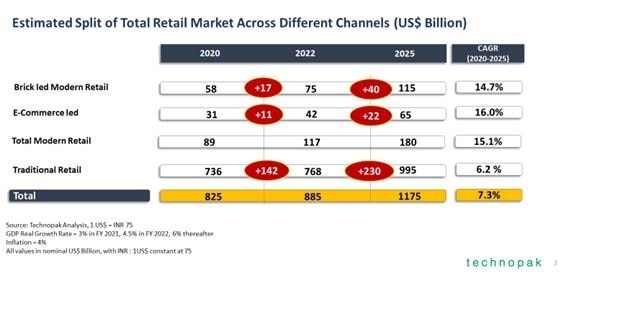 There are an estimated 17 million independent retailers (though some estimate this number to be closer to 30 million), and despite the relatively faster growth of modern, organised retail (brick and e-commerce-led), this number is still likely to increase to 20 (or more) million by 2025.In the backdrop of these facts, the shrill noise being made (since early 2000’s) by some quarters purporting to represent the interest of traditional “mom & pop” retailers and successive government's paying heed to such noises defies logic.The recent flip-flop on opening of e-commerce to the so-called “non-essential” goods is just one of the many that the Government of India has made in the last 15 years on policies relating to modernisation of India’s retail sector. However, the most recent one is perhaps the oddest one in current circumstances.
As India continues to be under the most severe lockdown that no other nation has yet enforced, there is almost no visible thinking from the government on steps that can still be taken (while under the lockdown) to reduce the damage to the economy. Private consumption accounts for over 58 percent of India’s GDP. Private consumption of merchandise alone accounts for almost 28 percent of the nation’s GDP.Beyond food and grocery, there are several other consumer product categories that have a very strong bearing on the health of the economy -- by way of creating jobs through manufacturing, distribution, and retail; and by way of contribution to the indirect tax kitty. It is therefore suicidal to disregard any interim solution that can keep some of this private consumption going without requiring customers to throng to traditional markets (that can compromise the nation’s fight against COVID-19).Removing the 'essentiality' restriction on e-commerce players could have achieved the objective of getting some of the private consumption back which could then have also helped in clearing some of the inventories of various kinds of consumer merchandise lying with manufacturers, distributors, and sellers on these e-commerce platforms.Yielding to the pressure from representatives of independent retailers at this time neither benefits such retailers whose outlets remain shut, nor does it help consumers, or the manufacturers of such consumer goods. Hence, while 4th May is still a few days away, the government should resolutely proceed by removing the current restrictions on e-commerce companies relating to what they can sell and what they cannot.
 Going ahead, it is indeed necessary that the government should come up with clear rules and a clear intent to enforce the rules governing the operations of various e-retail businesses (and especially the marketplaces). Predatory / disruptive / preferential pricing, if undertaken to gain some market share, has to be stopped in its tracks so that all sellers on the marketplaces get a fair access to consumers.Further, the government should encourage more national and international marketplace businesses so that competition can bring the commissions being charged by the marketplaces from the sellers and ensure it is fair to both the seller and the marketplace operator.In this context, the government should also consider creating (as a government-promoted but independently managed entity) a consumer-facing version of a marketplace, on the lines of Government’s e-Marketplace (GeM) with India Post becoming the logistics partner. On such a 'public utility' (and e-market places should be considered as a necessary public utility of our times), preference could be given to MSME manufacturers and sellers of all kinds of consumer products, with commissions aligned to the objective to delivering some profit to this entity that can cover the cost of capital put into creating and running such an entity.(The writer is Chairman and Managing Director of Technopak Advisors-a management consulting firm. He tweets @asinghal2004)
First Published:Apr 25, 2020, 10:31:27 IST
Advertisement
Advertisement

No premium queues, 30-minute target: What changes for Indian passport applicants in UAE
Indian passport applicants in the UAE can now access passport, visa and attestation services through Alhind’s 16 centres, with no premium queues, a Dh19 service fee and a target of completing applications within 30 minutes
4 min read
Bharat Forge, Flying Whales sign pact to develop 60-tonne airships for India’s defence logistics
Bharat Forge has signed an MoU with Flying Whales to jointly develop and manufacture 60-tonne heavy-lift airships in India for defence logistics, strategic mobility and disaster response
3 min read
Air India to cut Delhi-Toronto flight time by 3 hours, resume non-stop services from August 1
Air India will resume non-stop Delhi-Toronto flights from August 1, cutting travel time by nearly three hours and deploying its new Boeing 787-9 Dreamliner on the route
2 min read
South Korea economy grows faster than expected in Q2 as chip exports power recovery
South Korea’s economy grew 0.6% in the second quarter, beating expectations as strong semiconductor exports offset weakness in construction investment and domestic demand
2 min read
India remains among fastest-growing major economies despite global uncertainty, says RBI Bulletin
RBI says industrial and services activity stayed resilient through June, while strong trade, stable external sector and improving foreign investment continue to support economic growth.
1 min read
Advertisement
Advertisement