
Advertisement
Co Presented By
Co Presented By


Sections
May CPI at 21-month high: Even Raghuram Rajan will be praying to the rain gods
The CPI food inflation jumped to 7.55 percent from 6.4 percent in the preceding month, while the vegetable inflation shot up to 10.77 percent from 4.98 percent in the period

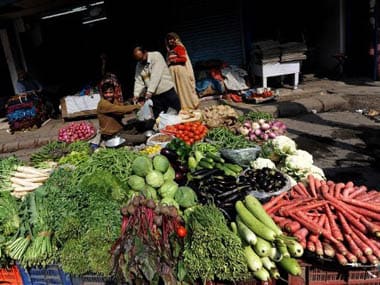 Reuters[/caption]This is the second straight month CPI is showing an upward momentum. The villain is clearly food prices which typically go up in the immediate months prior to the rains hit the land. The CPI food inflation jumped to 7.55 percent from 6.4 percent in the preceding month, while the vegetable inflation shot up to 10.77 percent from 4.98 percent in the period. The non-food part, the core inflation, has eased a bit to 4.7 percent from 4.9 percent reinforcing the notion that the overall uptrend is indeed due to the volatile food component.The RBI wants to contain inflation at 5 percent by March next year. In that context, Rajan wouldn’t be comfortable to see the upward trend in CPI, which the central bank mainly tracks these days for policy formulation, in consecutive months. The RBI will probably take a look at future rate cuts only if it is confident enough to meet the March-target.
At this stage, looking at the data, there are hardly any reasons for this confidence. The situation can even worse if it doesn’t rain well in July, causing a further spike in food prices. Monsoon has arrived in the southern part of the country largely on schedule but has taken a halt on way as it progresses to the western India.On the positive side, if rains do well this year, CPI inflation can surely ease in the approaching months as the core inflation figures indicate. This is something economists have highlighted too. “We expect adequate rains to eventually fade off the recent uptick in the prices of vegetables and fruits in subsequent months,” said Upasna Bhardwaj, economist at Kotak Mahindra Bank, in a note on Monday evening.Food managementBut, the RBI has only a limited role in solving the food inflation problem. The central bank doesn’t do food stock management but can only adjust the interest rates in the financial system.Here the task is with the government to efficiently manage the food basket by ensuring supply and offering the support prices. Among others, the shortage of sugar and pulses too has put upward pressure on inflation that could worsen in the festive season in the absence of adequate supply.The prices of pulses have come down in the recent months. During October-January, month-on-month, pulse prices rose by over 40 percent, reaching its peak of 46 percent in November. From that level, the month-on-month rise has eased to 31-34 percent in the recent months, primarily because of high imports. The government is indeed acting to curb the pule prices.But the real issue is the stagnant growth in cultivation and rising household demand on the other side. For many Indian households, pulses are the only source of proteins since they cannot afford egg or milk regularly.According to government statistics, the demand-supply gap is evident. This year, the pulses production stood at 170 lakh tonnes compared with 171 lakh tonnes last year, while the demand is increasing 10 lakh tonnes per year. In the current year, the demand is estimated around 246 lakh tonnes.RBI under pressureThe central bank, under Rajan, is under tremendous pressure to cut rates and is often criticised for the delay in lowering the rates as one has seen in the recent Subramaian Swamy-episode, where Rajan was personally attacked on keeping the rates high and ‘collapsing’ the economy.Under the new monetary policy frame work between the RBI and the government, the central bank’s primary job is to meet the inflation target. But, in the current context, the RBI’s headroom is very limited to control inflation. The scenario will turn ugly if monsoon fails since majority of the farmers depend on seasonal rains for irrigation.The short point is this. Just like the common man in India’s rural households, for whom the life has turned even more difficult on account of the high prices of food and vegetable items, the central bank governor too will be looking at the skies and praying to the rain gods for a good monsoon, for that is the only hope to contain the retail inflation. Data contributed by Kishor Kadam
First Published:Jun 14, 2016, 10:15:12 IST
Advertisement
Advertisement

US jobless claims fall to 187,000, signalling resilient labour market ahead of Fed meeting
US jobless claims fall to 187,000 as strong labour market reinforces Fed's inflation focus
1 min read
NDTA asks Connaught Place shops, offices and restaurants to close by 6:30 pm today
NDTA says move follows advisory from NDMC Chairman and Vice Chairman amid prevailing security situation in Connaught Place
1 min read
EU slaps Google with $1 billion antitrust fine over Play Store and Search practices
European Commission says Google unfairly favoured its own services on Search and the Play Store, violating the Digital Markets Act; the company calls the decision harmful to businesses and consumers.
1 min read
Brent crude flirts with $100, reigniting inflation and forex concerns for India
Experts say a prolonged rally above $100 per barrel is unlikely, but sustained high oil prices could push up inflation, widen the current account deficit and pressure the rupee.
2 min read
Can a record May offset a shrunk international schedule and help IndiGo turn a profit?
Record domestic market share boosts operating performance, but forex losses, rising oil prices and geopolitical disruptions could weigh on IndiGo's bottom line.
3 min read
Advertisement
Advertisement