
Advertisement
Co Presented By
Co Presented By


Sections
Jet Airways mess: Policy-makers, SBI must share blame for drift that puts textbook confusion over playbook clarity
Leading policy-makers/administrators have let a prized brand like Jet Airways to drift in mid-air to the point of it running out of fuel, and are responsible for a mess in which ideology and bureaucracy have got the better of creative responses.

It seems we are running out of aviation metaphors to describe the troubles facing Jet Airways. From trouble in the cockpit when founder-chairman Naresh Goyal could not muster capital to save the bleeding airline to its intended co-pilot Etihad Airways playing hide-and-seek and its air traffic controller a.k.a. leading lender State Bank of India (SBI) placing it in strategic limbo where it could neither land nor stay on course, there is a soup of confusion surrounding the ailing airline.Now, with its CEO and three top-level colleagues quitting this week to parachute their careers out of the airline, what we see ahead is a Bermuda Triangle situation. in which the premier airline that was a cult symbol of economic reform in the 1990s likely disappearing in a tragic trajectory, unless there are white knights waiting in the wings.The redoubtable UK-based Hindujas are now speculated upon as potential suitors to UAE's Etihad Airways that wants to be a significant minority player in the airline, but we will believe things when they happen. In the immediate instant, we can say one thing: Leading policy-makers/administrators have let a prized brand drift in mid-air to the point of it running out of fuel, and are responsible for a mess in which ideology and bureaucracy have got the better of creative responses. The sufferers in this game include employees, partners, bankers, taxpayers and passengers. It can barely get worse from here.![Representative image. Reuters]() Representative image. Reuters[/caption]But what we have witnessed instead is the cannibalisation of the airline in which pilots are fleeing or planning to, CXOs have quit and flying slots are up for basement sales. The brand bleeds like hell and loses further value. This is happening amid a jobs crisis in the country that sends wrong messages to young Indians, and a spurt in holiday season fares as competition ebbs.One would have expected CEA Subramanian, with his professorial background in the Indian School of Business, to bring some MBA love to this mess with a penchant for synergy. But what we saw instead was a clinical let-them-eat-cakes attitude as he wrote in favour of the dubious virtue of letting the market function because "the essence of a market economy is that those that have failed to utilise their assets productively must yield the space to others that utilise their assets well." Right, but why the drift? His superficial justification is that taxpayer money is better off staying away from the Jet Airways mess.I would like to ask: What if Jet Airways was treated as a going concern with the government playing the role of a smart private equity player to avoid loss of synergy? The airline has lost 75 percent of its market value this year—or about Rs 4,200 crore. Could the government have mounted an inspired Satyam-style rescue of the kind I had suggested to save itself a few thousand crore rupees? Or, better still, if SBI did take the haircut it has to, could it or any other taxpayer-funded agency have held on to a share stake and made significant capital gains in the future as India is a solid aviation market?True, all that would certainly require a way to handle Jet Airways' current liabilities, but a structured write-off with state backing may work better in the long run. No one seems to have thought on those lines. Entrepreneurial playbooks may work far better than textbook capitalism in a service industry company where people matter so much.
Representative image. Reuters[/caption]But what we have witnessed instead is the cannibalisation of the airline in which pilots are fleeing or planning to, CXOs have quit and flying slots are up for basement sales. The brand bleeds like hell and loses further value. This is happening amid a jobs crisis in the country that sends wrong messages to young Indians, and a spurt in holiday season fares as competition ebbs.One would have expected CEA Subramanian, with his professorial background in the Indian School of Business, to bring some MBA love to this mess with a penchant for synergy. But what we saw instead was a clinical let-them-eat-cakes attitude as he wrote in favour of the dubious virtue of letting the market function because "the essence of a market economy is that those that have failed to utilise their assets productively must yield the space to others that utilise their assets well." Right, but why the drift? His superficial justification is that taxpayer money is better off staying away from the Jet Airways mess.I would like to ask: What if Jet Airways was treated as a going concern with the government playing the role of a smart private equity player to avoid loss of synergy? The airline has lost 75 percent of its market value this year—or about Rs 4,200 crore. Could the government have mounted an inspired Satyam-style rescue of the kind I had suggested to save itself a few thousand crore rupees? Or, better still, if SBI did take the haircut it has to, could it or any other taxpayer-funded agency have held on to a share stake and made significant capital gains in the future as India is a solid aviation market?True, all that would certainly require a way to handle Jet Airways' current liabilities, but a structured write-off with state backing may work better in the long run. No one seems to have thought on those lines. Entrepreneurial playbooks may work far better than textbook capitalism in a service industry company where people matter so much.
The three gentlemen forming a Bermuda Triangle (that strange Caribbean spot where aircraft were known to disappear mysteriously) would include Chief Economic Advisor Krishnamurthy Subramanian and SBI chairman Rajnish Kumar. The third angle, M S Sahoo, head, Insolvency and Bankruptcy Board of India (IBC) deserves an honourable mention for suggesting that companies are best treated as "going concerns" in the resolution of companies in or around bankruptcy. He said recently that it would be "dangerous" to let viable firms close down.First up, the principle of synergy is defined as one in which the "interaction or cooperation of two or more organisations, substances, or other agents" produce a combined effect greater than the sum of their separate effects. Applied to Jet Airways this would mean that the talent and work of its crew, the route slots it has, the aircraft it controls and its brand value (among other things) should combine to produce a solid effect to at least minimise the financial damage caused by its inability to service or pay back loans.[caption id="attachment_6637731" align="alignleft" width="380"]
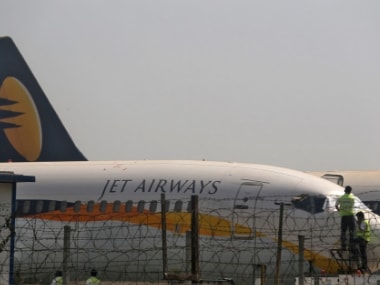 Representative image. Reuters[/caption]But what we have witnessed instead is the cannibalisation of the airline in which pilots are fleeing or planning to, CXOs have quit and flying slots are up for basement sales. The brand bleeds like hell and loses further value. This is happening amid a jobs crisis in the country that sends wrong messages to young Indians, and a spurt in holiday season fares as competition ebbs.One would have expected CEA Subramanian, with his professorial background in the Indian School of Business, to bring some MBA love to this mess with a penchant for synergy. But what we saw instead was a clinical let-them-eat-cakes attitude as he wrote in favour of the dubious virtue of letting the market function because "the essence of a market economy is that those that have failed to utilise their assets productively must yield the space to others that utilise their assets well." Right, but why the drift? His superficial justification is that taxpayer money is better off staying away from the Jet Airways mess.I would like to ask: What if Jet Airways was treated as a going concern with the government playing the role of a smart private equity player to avoid loss of synergy? The airline has lost 75 percent of its market value this year—or about Rs 4,200 crore. Could the government have mounted an inspired Satyam-style rescue of the kind I had suggested to save itself a few thousand crore rupees? Or, better still, if SBI did take the haircut it has to, could it or any other taxpayer-funded agency have held on to a share stake and made significant capital gains in the future as India is a solid aviation market?True, all that would certainly require a way to handle Jet Airways' current liabilities, but a structured write-off with state backing may work better in the long run. No one seems to have thought on those lines. Entrepreneurial playbooks may work far better than textbook capitalism in a service industry company where people matter so much.
SBI chairman Rajnish Kumar has said his bank has taken steps disproportionate to its own loan book to keep Jet Airways flying. Extending the same logic we could have asked: Why not throw some smart money and advice in an entrepreneurial manner in concert with the government (SBI's chief owner) to get some extra long-term gain? Here is some basic arithmetic: SBI's exposure to Jet Airways is Rs 1,600 crore, while its market cap loss this year is Rs 4,200 crore. Get the picture?IBBI's Sahoo has said time and again that the focus should be on resolution and not liquidation. The cannibalisation of Jet Airways suggests the opposite. Lenders are finally moving towards finding a way out of the mess by looking at approaching unsolicited bidders. But why so little and so late? The attempt by a consortium of Jet Airways employees' to take over the airline could have been pro-actively encouraged. Most large companies in India are run by professional managers—not owners—anyway.“There is no mathematical formula to say that a company is unviable and another is viable. It depends on so many considerations and who is looking at it," IBBI's Sahoo said recently. Those words should have come from someone in the finance ministry or the SBI. Hopefully, the new government taking charge after the current round of elections would have people who think less like bureaucrats and more like entrepreneurs.(The writer is a senior journalist and commentator. He tweets as @madversity)
First Published:May 15, 2019, 16:08:28 IST
Advertisement
Advertisement

US jobless claims fall to 187,000, signalling resilient labour market ahead of Fed meeting
US jobless claims fall to 187,000 as strong labour market reinforces Fed's inflation focus
1 min read
NDTA asks Connaught Place shops, offices and restaurants to close by 6:30 pm today
NDTA says move follows advisory from NDMC Chairman and Vice Chairman amid prevailing security situation in Connaught Place
1 min read
EU slaps Google with $1 billion antitrust fine over Play Store and Search practices
European Commission says Google unfairly favoured its own services on Search and the Play Store, violating the Digital Markets Act; the company calls the decision harmful to businesses and consumers.
1 min read
Brent crude flirts with $100, reigniting inflation and forex concerns for India
Experts say a prolonged rally above $100 per barrel is unlikely, but sustained high oil prices could push up inflation, widen the current account deficit and pressure the rupee.
2 min read
Can a record May offset a shrunk international schedule and help IndiGo turn a profit?
Record domestic market share boosts operating performance, but forex losses, rising oil prices and geopolitical disruptions could weigh on IndiGo's bottom line.
3 min read
Advertisement
Advertisement