
Advertisement
Co Presented By
Co Presented By


Sections
India can't have single rate GST, 3-slab structure possible, says CEA Arvind Subramanian
Goods and Services Tax (GST) is a "work in progress" and there is a need for further simplification of rates with fewer exemptions and simpler policies.

New Delhi: Ruling out a single rate Goods and Services Tax (GST), Chief Economic Advisor Arvind Subramanian on Wednesday pitched for a three-rate structure going forward as revenues stabilise.He said GST is a "work in progress" and there is a need for further simplification of rates with fewer exemptions and simpler policies.![File photo of Arvind Subramanian. Reuters]() File photo of Arvind Subramanian. Reuters[/caption]Union Minister Arun Jaitley too had dismissed the idea of a single rate GST as "flawed" saying that it can only work in a country where the entire population has 'similar and high' capacity to spend.Subramanian said that GST implementation "has not been too bad" in the first year of difficult implementation."My own view is the more you rely on a carrot, and less you rely on sticks, you facilitate formalisation of the economy. That's what I like about GST. It is not heavy-handed. Its a kind of self-policing," he said.GST, which subsumed over a dozen local taxes, was rolled out on 1 July 2017.The CEA headed panel had in its report way back in 2015 had recommended a range for revenue-neutral rate (RNR) of 15-15.5 percent for the proposed GST, with a preference for the lower one.It also suggested a range of standard' tax rate of 17-18 percent for the bulk of goods and services, while recommending 12 percent for low rate goods' and 40 percent for demerit goods like the luxury car, aerated beverages, pan masala, and tobacco. For precious metal, it recommended a range of 2-6 percent.Besides, Subramanian also said that India needs an independent fiscal council which brings out independent views on how government does accounting for public finances."One of the things we all were unanimously in favour of was a fiscal council. I think we need to get more independent people doing this (government accounting) with better access to data...People should have trust that everything is properly accounted for, he said.
File photo of Arvind Subramanian. Reuters[/caption]Union Minister Arun Jaitley too had dismissed the idea of a single rate GST as "flawed" saying that it can only work in a country where the entire population has 'similar and high' capacity to spend.Subramanian said that GST implementation "has not been too bad" in the first year of difficult implementation."My own view is the more you rely on a carrot, and less you rely on sticks, you facilitate formalisation of the economy. That's what I like about GST. It is not heavy-handed. Its a kind of self-policing," he said.GST, which subsumed over a dozen local taxes, was rolled out on 1 July 2017.The CEA headed panel had in its report way back in 2015 had recommended a range for revenue-neutral rate (RNR) of 15-15.5 percent for the proposed GST, with a preference for the lower one.It also suggested a range of standard' tax rate of 17-18 percent for the bulk of goods and services, while recommending 12 percent for low rate goods' and 40 percent for demerit goods like the luxury car, aerated beverages, pan masala, and tobacco. For precious metal, it recommended a range of 2-6 percent.Besides, Subramanian also said that India needs an independent fiscal council which brings out independent views on how government does accounting for public finances."One of the things we all were unanimously in favour of was a fiscal council. I think we need to get more independent people doing this (government accounting) with better access to data...People should have trust that everything is properly accounted for, he said.
"In India, we can never have one rate. I had recommended a standard rate and one for demerit good, one for a low rate. I think, in India, the debate should be about 'why can't we have three', rather than 'why not one'," Subramanian said at an NCAER event here.Under the GST regime, there are four rates -- 5 percent, 12 percent, 18 percent and 28 percent. Luxury and demerit goods are subject to cess on top of the highest slab.The single rate GST structure was advocated by Congress President Rahul Gandhi.Subramanian said since GST is a regressive tax, it won't be "fair" to have a single rate structure unless there are instruments to protect the poor who get hurt by rising costs."...I think over time we will see simplification. For example, once the revenue stabilises, 28 percent can (be rationalised).... but the broader point I want to make is that why can't we have three (tax slabs). That's what we should ask for," said Subramanian.[caption id="attachment_4326481" align="alignleft" width="380"]
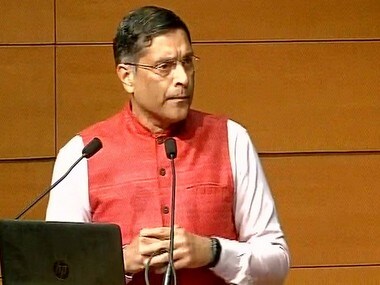 File photo of Arvind Subramanian. Reuters[/caption]Union Minister Arun Jaitley too had dismissed the idea of a single rate GST as "flawed" saying that it can only work in a country where the entire population has 'similar and high' capacity to spend.Subramanian said that GST implementation "has not been too bad" in the first year of difficult implementation."My own view is the more you rely on a carrot, and less you rely on sticks, you facilitate formalisation of the economy. That's what I like about GST. It is not heavy-handed. Its a kind of self-policing," he said.GST, which subsumed over a dozen local taxes, was rolled out on 1 July 2017.The CEA headed panel had in its report way back in 2015 had recommended a range for revenue-neutral rate (RNR) of 15-15.5 percent for the proposed GST, with a preference for the lower one.It also suggested a range of standard' tax rate of 17-18 percent for the bulk of goods and services, while recommending 12 percent for low rate goods' and 40 percent for demerit goods like the luxury car, aerated beverages, pan masala, and tobacco. For precious metal, it recommended a range of 2-6 percent.Besides, Subramanian also said that India needs an independent fiscal council which brings out independent views on how government does accounting for public finances."One of the things we all were unanimously in favour of was a fiscal council. I think we need to get more independent people doing this (government accounting) with better access to data...People should have trust that everything is properly accounted for, he said.
First Published:Jul 12, 2018, 09:06:07 IST
Advertisement
Advertisement

Brent crude flirts with $100, reigniting inflation and forex concerns for India
Experts say a prolonged rally above $100 per barrel is unlikely, but sustained high oil prices could push up inflation, widen the current account deficit and pressure the rupee.
2 min read
Can a record May offset a shrunk international schedule and help IndiGo turn a profit?
Record domestic market share boosts operating performance, but forex losses, rising oil prices and geopolitical disruptions could weigh on IndiGo's bottom line.
3 min read
China has dominated Myanmar’s rare earth mines — now India eyes deal to harness country’s critical minerals
India is deepening rare earth cooperation with Myanmar as New Delhi seeks alternative sources of critical minerals dominated by China, including dysprosium and terbium used in EVs, defence systems and clean energy technologies
6 min read
JPMorgan to hire 1,000 technology professionals for India GCCs amid AI-led transformation
Wall Street banking giant to expand hiring across cloud, cybersecurity and AI data pipeline roles as it strengthens its India Global Capability Centres despite AI-driven workforce optimisation.
1 min read
BOJ seen raising interest rates by December as weak yen fuels inflation risks
Majority of economists expect Japan's central bank to deliver a 25-basis-point rate hike by year-end, with further policy tightening likely through 2027.
2 min read
Advertisement
Advertisement