



Former governor Bimal Jalan panel on RBI's Economic Capital Framework to submit report next month
The six-member Jalan panel was appointed on December 26, 2018 to review the Economic Capital Framework for the RBI

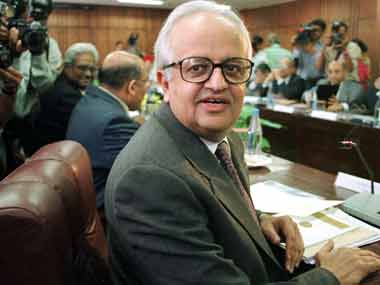
File photo of Bimal Jalan, former governor, RBI
Reuters[/caption]The panel has been entrusted with the task of reviewing the best practices followed by central banks worldwide in making assessment and provisions for risks.The panel, having former economic affairs secretary Rakesh Mohan as its vice chairman, will propose a suitable profit distribution policy, taking into account all the likely situations of the RBI, including the requirement of holding more provisions than required.The government and the RBI under previous governor Urjit Patel had been at loggerheads over the Rs 9.6 lakh crore surplus capital with the central bank.The finance ministry was of the view that the buffer of 28 percent of gross assets maintained by the central bank is well above the global norm of around 14 percent. Following this, the RBI board in its meeting on 19 November, 2018 decided to constitute a panel to examine Economic Capital Framework.In the past, the issue of the ideal size of the Reserve Bank of India reserves was examined by three committees -- V Subrahmanyam in 1997, Usha Thorat in 2004 and YH Malegam in 2013.While the Subrahmanyam panel recommended for building a 12 percent contingency reserve, the Thorat panel suggested it should be maintained at a higher 18 percent of the total assets of the central bank.The RBI board did not accept the recommendation of the Thorat committee and decided to continue with the recommendation of the Subrahmanyam committee.The Malegam panel said the RBI should transfer an adequate amount of its profit to the contingency reserves annually but did not ascribe any particular number.According to a report of by Bank of America Merrill Lynch, the Jalan committee is likely to identify an excess buffer of up to Rs 3 lakh crore. This includes the excess capital in contingency reserves and also revaluation of reserves.Halving of the contingency reserves to a level of 3.25 percent from the present 6.5 percent will release Rs 1.282 lakh crore, the report said, pointing out that the level is still 50 percent higher than what central banks in the BRICS (Brazil, Russia, India, China and South Africa) grouping have.Similarly, halving the yield cover hike to 4.5 percent from the present 9 percent will release another Rs 1.170 lakh crore, it said.

Tesla sells more cars but makes less money: Why Musk’s AI pivot is squeezing profits
No premium queues, 30-minute target: What changes for Indian passport applicants in UAE
Bharat Forge, Flying Whales sign pact to develop 60-tonne airships for India’s defence logistics
Air India to cut Delhi-Toronto flight time by 3 hours, resume non-stop services from August 1
South Korea economy grows faster than expected in Q2 as chip exports power recovery