
Advertisement
Co Presented By
Co Presented By


Sections
Demonetisation rollout 'deeply flawed', Rs 2,000 notes launch puzzling, says Nobel laureate Richard Thaler
it is clear now that Thaler never supported Modi's drive and even considered it deeply flawed.

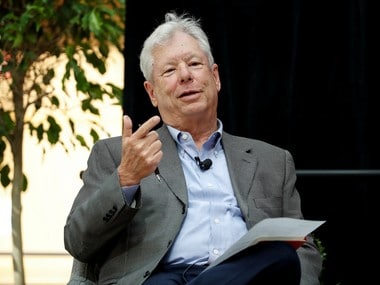
Nobel laureate economist Richard Thaler has clarified that demonetisation of high value currencies per se is a good move, but the way it was done by Prime Minister Narendra Modi is "deeply flawed".[caption id="attachment_4127155" align="alignleft" width="380"]![US economist Richard Thaler, of the University of Chicago Booth School of Business. Reuters]() US economist Richard Thaler, of the University of Chicago Booth School of Business. Reuters[/caption]Thaler clarified his stance to his student Swaraj Kumar in an email exchange, which both of them tweeted.“The concept was good as a move to a cashless society to impede corruption but the rollout was deeply flawed and the introduction of the Rs 2000 note makes the motivation for the entire exercise puzzling,” Thaler told Kumar.Thaler won the Nobel prize for economics this year. Soon after the announcement, Bharatiya Janata Party (BJP) leaders had claimed on Twitter that Thaler had supported the demonetisation of Rs 500 and Rs 1,000 notes announced by Modi on 8 November, 2016. However, even then it turned out that though in principle he supported such a move towards cashless economy, he had reservations about introduction of Rs 2,000 notes.The twitter exchange between Thaler and Kumar was brought out by Rupa Subramanya who also tagged Thaler who retweeted her tweet:Now, with the latest development, it is clear that Thaler never supported Modi's drive and even considered it deeply flawed.The move had sucked out 86 percent of the currency in circulation and even resulted in deaths and depression among citizens. The slowdown in the economy has been partly attributed to the ban on notes which crippled the small-scale sector.The introduction of Rs 2,000 notes has been criticised by many experts earlier too. A section of the economists questioned the very objective of the move asking if Rs 2,000 notes are being introduced, how would ban on Rs 500 and Rs 1,000 notes be effective.According to media reports, soon after the ban announcement, the government's note printing presses worked overtime to print the Rs 2,000 notes. The idea was to meet the demand for currencies at the earliest.However, that did not help the people as they were stuck with the high value note as there were not enough lower denominations available.However, the Reserve Bank of India (RBI) has now stopped printing Rs 2000 notes, with the focus shifting to lower denominations.
US economist Richard Thaler, of the University of Chicago Booth School of Business. Reuters[/caption]Thaler clarified his stance to his student Swaraj Kumar in an email exchange, which both of them tweeted.“The concept was good as a move to a cashless society to impede corruption but the rollout was deeply flawed and the introduction of the Rs 2000 note makes the motivation for the entire exercise puzzling,” Thaler told Kumar.Thaler won the Nobel prize for economics this year. Soon after the announcement, Bharatiya Janata Party (BJP) leaders had claimed on Twitter that Thaler had supported the demonetisation of Rs 500 and Rs 1,000 notes announced by Modi on 8 November, 2016. However, even then it turned out that though in principle he supported such a move towards cashless economy, he had reservations about introduction of Rs 2,000 notes.The twitter exchange between Thaler and Kumar was brought out by Rupa Subramanya who also tagged Thaler who retweeted her tweet:Now, with the latest development, it is clear that Thaler never supported Modi's drive and even considered it deeply flawed.The move had sucked out 86 percent of the currency in circulation and even resulted in deaths and depression among citizens. The slowdown in the economy has been partly attributed to the ban on notes which crippled the small-scale sector.The introduction of Rs 2,000 notes has been criticised by many experts earlier too. A section of the economists questioned the very objective of the move asking if Rs 2,000 notes are being introduced, how would ban on Rs 500 and Rs 1,000 notes be effective.According to media reports, soon after the ban announcement, the government's note printing presses worked overtime to print the Rs 2,000 notes. The idea was to meet the demand for currencies at the earliest.However, that did not help the people as they were stuck with the high value note as there were not enough lower denominations available.However, the Reserve Bank of India (RBI) has now stopped printing Rs 2000 notes, with the focus shifting to lower denominations.
 US economist Richard Thaler, of the University of Chicago Booth School of Business. Reuters[/caption]Thaler clarified his stance to his student Swaraj Kumar in an email exchange, which both of them tweeted.“The concept was good as a move to a cashless society to impede corruption but the rollout was deeply flawed and the introduction of the Rs 2000 note makes the motivation for the entire exercise puzzling,” Thaler told Kumar.Thaler won the Nobel prize for economics this year. Soon after the announcement, Bharatiya Janata Party (BJP) leaders had claimed on Twitter that Thaler had supported the demonetisation of Rs 500 and Rs 1,000 notes announced by Modi on 8 November, 2016. However, even then it turned out that though in principle he supported such a move towards cashless economy, he had reservations about introduction of Rs 2,000 notes.The twitter exchange between Thaler and Kumar was brought out by Rupa Subramanya who also tagged Thaler who retweeted her tweet:Now, with the latest development, it is clear that Thaler never supported Modi's drive and even considered it deeply flawed.The move had sucked out 86 percent of the currency in circulation and even resulted in deaths and depression among citizens. The slowdown in the economy has been partly attributed to the ban on notes which crippled the small-scale sector.The introduction of Rs 2,000 notes has been criticised by many experts earlier too. A section of the economists questioned the very objective of the move asking if Rs 2,000 notes are being introduced, how would ban on Rs 500 and Rs 1,000 notes be effective.According to media reports, soon after the ban announcement, the government's note printing presses worked overtime to print the Rs 2,000 notes. The idea was to meet the demand for currencies at the earliest.However, that did not help the people as they were stuck with the high value note as there were not enough lower denominations available.However, the Reserve Bank of India (RBI) has now stopped printing Rs 2000 notes, with the focus shifting to lower denominations.
First Published:Nov 20, 2017, 07:39:42 IST
Advertisement
Advertisement

NDTA asks Connaught Place shops, offices and restaurants to close by 6:30 pm today
NDTA says move follows advisory from NDMC Chairman and Vice Chairman amid prevailing security situation in Connaught Place
1 min read
EU slaps Google with $1 billion antitrust fine over Play Store and Search practices
European Commission says Google unfairly favoured its own services on Search and the Play Store, violating the Digital Markets Act; the company calls the decision harmful to businesses and consumers.
1 min read
Brent crude flirts with $100, reigniting inflation and forex concerns for India
Experts say a prolonged rally above $100 per barrel is unlikely, but sustained high oil prices could push up inflation, widen the current account deficit and pressure the rupee.
2 min read
Can a record May offset a shrunk international schedule and help IndiGo turn a profit?
Record domestic market share boosts operating performance, but forex losses, rising oil prices and geopolitical disruptions could weigh on IndiGo's bottom line.
3 min read
China has dominated Myanmar’s rare earth mines — now India eyes deal to harness country’s critical minerals
India is deepening rare earth cooperation with Myanmar as New Delhi seeks alternative sources of critical minerals dominated by China, including dysprosium and terbium used in EVs, defence systems and clean energy technologies
6 min read
Advertisement
Advertisement