
Advertisement
Co Presented By
Co Presented By


Sections
Centre should sell BSNL after dismantling it rather than extending bailout package to keep telco ringing
The interesting thing is that once upon a time, BSNL used to make a lot of money.

In the recent past, there have been a spate of news reports regarding a few institutions in the public sector being in trouble.The Bengaluru-based Hindustan Aeronautics Ltd (HAL) has had to borrow money to pay salaries. The Mumbai-based Tata Institute of Fundamental Research has issued a notice to its faculty and students that they will be paid only half of what is due for February 2019, due to a shortage of funds.[caption id="attachment_4510919" align="alignleft" width="380"]![Representational image. Reuters]() Representational image. Reuters[/caption]Over and above this, the employees of Bharat Sanchar Nigam Ltd (BSNL), the government owned telecom company, haven’t been paid salaries for February 2019. (As I finished writing the piece, it seems the government has decided to release Rs 850 crore before Holi to pay salaries to the BSNL employees).Along with this, the Business Standard reports that the department of telecom is planning a Rs 13,000-crore bailout of BSNL. The bailout plan includes Rs 6,767 crore of infusion of fresh capital by the government into the company. The remaining money will go towards the voluntary retirement package.Of the three examples here, BSNL is the main problem of the government. Let’s take a look at this point-wise.1) Take a look at the accompanying chart. It plots the profit/losses made by BSNL over the years.[caption id="attachment_6259951" align="alignnone" width="981"]
Representational image. Reuters[/caption]Over and above this, the employees of Bharat Sanchar Nigam Ltd (BSNL), the government owned telecom company, haven’t been paid salaries for February 2019. (As I finished writing the piece, it seems the government has decided to release Rs 850 crore before Holi to pay salaries to the BSNL employees).Along with this, the Business Standard reports that the department of telecom is planning a Rs 13,000-crore bailout of BSNL. The bailout plan includes Rs 6,767 crore of infusion of fresh capital by the government into the company. The remaining money will go towards the voluntary retirement package.Of the three examples here, BSNL is the main problem of the government. Let’s take a look at this point-wise.1) Take a look at the accompanying chart. It plots the profit/losses made by BSNL over the years.[caption id="attachment_6259951" align="alignnone" width="981"]![Source: Public Enterprises Surveys of Various Years.]() Source: Public Enterprises Surveys of Various Years.[/caption]Since 2009-10, BSNL has made losses of Rs 57,676 crore. This is the highest among all government-owned companies, even higher than that of perpetual trouble-child of the government, Air India.The company’s expected loss in 2018-19 is likely to be more than Rs 7,000 crore. In this scenario, the banks are not willing to give short-term loans to BSNL (and why should they, given that public sector banks themselves are not in a great shape). This has led to the company being unable to pay its salaries for the last month.2) The interesting thing is that once upon a time, BSNL used to make a lot of money. Between 2004-05 and 2008-09, the company made a profit of Rs 30,513 crore. In fact, in 2004-05, the company made a profit of Rs 10,183 crore, and was the second most profitable public sector enterprise, after ONGC. Those were its heydays.3) What happened after that? The company’s main business model of landline phones went for a toss. As mobile phone prices as well as usage prices fell, more and more people moved away from landline phones. Also, public sector companies tend to do well when there is very little competition in the sector that they operate in.Post 2005, the competition in the telecom sector went up, first in the form of more companies, and then in the form of lower prices. BSNL clearly wasn’t ready for all the competition, with employee cost forming a bulk of its operating expenditure, unlike private companies like Airtel and Vodafone, which had outsourced most of their operations to other companies and primarily operated as marketing companies.The entry of Reliance Jio with very low prices for data, hurt further.4) Over the last decade, the performance of the company has gone from bad to worse. And now there is talk about the government spending Rs 13,000 crore to bail out the company. This is basically throwing good money after bad and more government money going down the drain.5) On its own, BSNL is too large an organisation and given that it is too unwieldy as well. The government should look at dividing BSNL into several smaller companies, like the AT&T was divided in the United States and selling them piece by piece.
Source: Public Enterprises Surveys of Various Years.[/caption]Since 2009-10, BSNL has made losses of Rs 57,676 crore. This is the highest among all government-owned companies, even higher than that of perpetual trouble-child of the government, Air India.The company’s expected loss in 2018-19 is likely to be more than Rs 7,000 crore. In this scenario, the banks are not willing to give short-term loans to BSNL (and why should they, given that public sector banks themselves are not in a great shape). This has led to the company being unable to pay its salaries for the last month.2) The interesting thing is that once upon a time, BSNL used to make a lot of money. Between 2004-05 and 2008-09, the company made a profit of Rs 30,513 crore. In fact, in 2004-05, the company made a profit of Rs 10,183 crore, and was the second most profitable public sector enterprise, after ONGC. Those were its heydays.3) What happened after that? The company’s main business model of landline phones went for a toss. As mobile phone prices as well as usage prices fell, more and more people moved away from landline phones. Also, public sector companies tend to do well when there is very little competition in the sector that they operate in.Post 2005, the competition in the telecom sector went up, first in the form of more companies, and then in the form of lower prices. BSNL clearly wasn’t ready for all the competition, with employee cost forming a bulk of its operating expenditure, unlike private companies like Airtel and Vodafone, which had outsourced most of their operations to other companies and primarily operated as marketing companies.The entry of Reliance Jio with very low prices for data, hurt further.4) Over the last decade, the performance of the company has gone from bad to worse. And now there is talk about the government spending Rs 13,000 crore to bail out the company. This is basically throwing good money after bad and more government money going down the drain.5) On its own, BSNL is too large an organisation and given that it is too unwieldy as well. The government should look at dividing BSNL into several smaller companies, like the AT&T was divided in the United States and selling them piece by piece.
 Representational image. Reuters[/caption]Over and above this, the employees of Bharat Sanchar Nigam Ltd (BSNL), the government owned telecom company, haven’t been paid salaries for February 2019. (As I finished writing the piece, it seems the government has decided to release Rs 850 crore before Holi to pay salaries to the BSNL employees).Along with this, the Business Standard reports that the department of telecom is planning a Rs 13,000-crore bailout of BSNL. The bailout plan includes Rs 6,767 crore of infusion of fresh capital by the government into the company. The remaining money will go towards the voluntary retirement package.Of the three examples here, BSNL is the main problem of the government. Let’s take a look at this point-wise.1) Take a look at the accompanying chart. It plots the profit/losses made by BSNL over the years.[caption id="attachment_6259951" align="alignnone" width="981"]
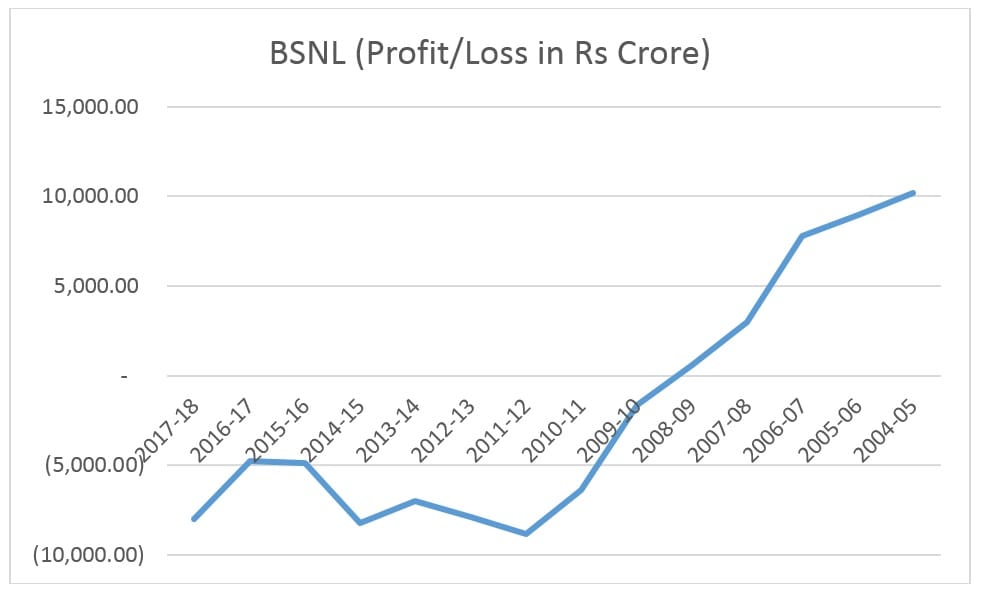 Source: Public Enterprises Surveys of Various Years.[/caption]Since 2009-10, BSNL has made losses of Rs 57,676 crore. This is the highest among all government-owned companies, even higher than that of perpetual trouble-child of the government, Air India.The company’s expected loss in 2018-19 is likely to be more than Rs 7,000 crore. In this scenario, the banks are not willing to give short-term loans to BSNL (and why should they, given that public sector banks themselves are not in a great shape). This has led to the company being unable to pay its salaries for the last month.2) The interesting thing is that once upon a time, BSNL used to make a lot of money. Between 2004-05 and 2008-09, the company made a profit of Rs 30,513 crore. In fact, in 2004-05, the company made a profit of Rs 10,183 crore, and was the second most profitable public sector enterprise, after ONGC. Those were its heydays.3) What happened after that? The company’s main business model of landline phones went for a toss. As mobile phone prices as well as usage prices fell, more and more people moved away from landline phones. Also, public sector companies tend to do well when there is very little competition in the sector that they operate in.Post 2005, the competition in the telecom sector went up, first in the form of more companies, and then in the form of lower prices. BSNL clearly wasn’t ready for all the competition, with employee cost forming a bulk of its operating expenditure, unlike private companies like Airtel and Vodafone, which had outsourced most of their operations to other companies and primarily operated as marketing companies.The entry of Reliance Jio with very low prices for data, hurt further.4) Over the last decade, the performance of the company has gone from bad to worse. And now there is talk about the government spending Rs 13,000 crore to bail out the company. This is basically throwing good money after bad and more government money going down the drain.5) On its own, BSNL is too large an organisation and given that it is too unwieldy as well. The government should look at dividing BSNL into several smaller companies, like the AT&T was divided in the United States and selling them piece by piece.
The trouble here will be that no private company will want to deal with the lazy ways of a public sector workforce. And of course, the trade unions will oppose. Nonetheless, this should be given a shot because enough hard-earned money of the taxpayers has been used to keep the company going. That needs to stop.Further, BSNL owns a lot of real estate, in the heart of many cities and towns across India. The government should first look to make an inventory of all the land that BSNL owns, and then sell it gradually piece by piece. Other than opening up more space in cities and towns, it will also help the government to earn some money.To conclude, the government needs to focus on the core issues of education, health, agriculture, foreign policy, defence, regulation and cutting down procedures and processes, so that India’s small and medium enterprises can flourish and create jobs in the process.There is no point in the government owning a loss-making telecom company. But then this is something that has been said many a time in the past.(The writer is an economist and author of the Easy Money trilogy)
First Published:Mar 14, 2019, 16:31:16 IST
Advertisement
Advertisement

BOJ seen raising interest rates by December as weak yen fuels inflation risks
Majority of economists expect Japan's central bank to deliver a 25-basis-point rate hike by year-end, with further policy tightening likely through 2027.
2 min read
'From make in India to launch from India': Skyroot COO on why Vikram-1 could change India’s space sector
Skyroot Aerospace’s successful Vikram-1 mission marks a major milestone for India’s private space sector, as the country seeks to shift from “Make in India” to “Launch from India” and compete in the global commercial satellite launch market
8 min read
Google burns cash for first time as AI spending pushes 2026 capex to $205 billion
Google parent Alphabet reported negative free cash flow of $5.9 billion in the second quarter for the first time since going public, as surging AI infrastructure spending pushed its 2026 capital expenditure forecast to as much as $205 billion
6 min read
Tesla sells more cars but makes less money: Why Musk’s AI pivot is squeezing profits
Tesla’s record Q2 deliveries failed to translate into higher profits as price cuts, falling regulatory-credit revenue and Elon Musk’s aggressive AI spending squeezed margins and pushed the EV maker into negative free cash flow
5 min read
No premium queues, 30-minute target: What changes for Indian passport applicants in UAE
Indian passport applicants in the UAE can now access passport, visa and attestation services through Alhind’s 16 centres, with no premium queues, a Dh19 service fee and a target of completing applications within 30 minutes
4 min read
Advertisement
Advertisement