



Caste theory to explain Manesar violence may be bunkum
The alleged trigger for the violence at Manesar - casteist remarks by a supervisor - appears unlikely since the supervisor was also a Dalit.

Given the massive scale of the Maruti mayhem on 18 July, it was always improbable that a casteist remark by one supervisor could have triggered it all.
Now, it seems the caste slur theory can be debunked completely, though we will have to await the results of the official investigation for the final word. According to a report in The Times of India, the supervisor who allegedly passed casteist comments against Dalit worker Jiyalal was also a Dallit.
Its supervisor has been identified as Sangram Singh, a Dalit, and the management had suspended Jiyalal for allegedly slapping Singh.
[caption id="attachment_390229" align="alignleft" width="380"]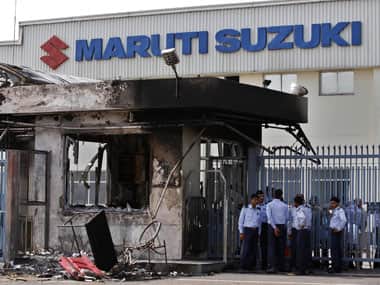 Maruti's supervisor has been identified as Sangram Singh, a Dalit, and the management had suspended Jiyalal for allegedly slapping Singh. AP[/caption]
Quoting unnamed Haryana labour department officials, the newspaper said: "Tension flared up when the management refused to immediately reinstate Jiyalal, who had been suspended for slapping Sangram Singh. The management gave in to the workers' sustained pressure, but on the condition that the reinstatement would be done on Friday, after he gave an undertaking to behave well. However, the workers insisted on immediate reinstatement."
 More from Business
However, the union viewpoint seems to be stuck on this alleged casteist grievance, as this statement by the New Trade Union Initiative (NTUI) suggests. NTUI, which has no direct affiliation to the Maruti Suzuki Workers' Union at Manesar, said in a statement two days ago: "The present spate of violence at the Manesar plant of Maruti Suzuki as a fallout of a protest by workers against a casteist comment made by a supervisor at a Dalit worker reflects the continuing use of 'caste' as a method of subordination and oppression, reflecting the persistence of deeply-rooted primordial structures of society that complement capitalist exploitation."
However, so far the union has delivered no proof for its caste theory of violence, at least in the case of Manesar. The union has also been alleging that Maruti was not implementing its previous agreements with worker unions, which led to a lot of industrial unrest last year at Manesar.
But this too seems unlikely. NDTV, quoting the Additional Labour Commissioner of Haryana, Naresh Nawal, says that there was no breach of the agreements signed by workers and the Maruti management in October last year. "Workers were satisfied. It was never an issue. It was a suspension matter which they were negotiating," Nawal was quoted as saying.
Nawal's statement seems believeable, since he also debunks the management theory that the violence was pre-planned. He said there was a labour officer present that day when management and workers were talking about the suspension: "It was not pre-planned or anything. It was only an issue of suspension. Workers wanted it revoked that very day while the management asked them to wait for the supervisor," Nawal said.
Haryana's Industry Minister Randeep Singh Surjewala has gone further and said that the violence at Maruti had nothing to do with labour-management strife.
He told The Economic Times in an interview: "This is not a case of labour unrest. There is more to it. It seems to be a conspiracy to disrupt the industrial peace not only in Maruti, but across the industrial sector in the state."
We will, of course, have to wait for official confirmation of these claims and counter-facts, but it seems at least one leg of their theory - that it all started with casteist remarks - can tentatively be laid to rest.

Google burns cash for first time as AI spending pushes 2026 capex to $205 billion
Tesla sells more cars but makes less money: Why Musk’s AI pivot is squeezing profits
No premium queues, 30-minute target: What changes for Indian passport applicants in UAE
Bharat Forge, Flying Whales sign pact to develop 60-tonne airships for India’s defence logistics
Air India to cut Delhi-Toronto flight time by 3 hours, resume non-stop services from August 1