
Advertisement
Co Presented By
Co Presented By


Sections
Cash crunch: Cashless economy is still far away; govt hasn't done enough to push digital transactions
The steps thus far taken by the government are few and unsubstantial like 0.75 percent cash back on card payments in petrol bunks, waiver of user charges for online booking of rail tickets, etc.

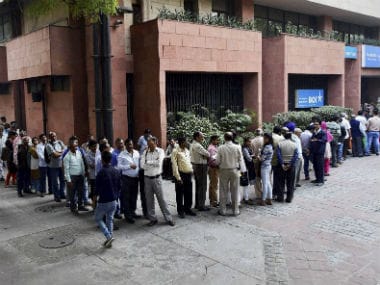 Representational image of people queueing up before an ATM. PTI[/caption]Let us face it. The serpentine queues in front of the ATMs at the first hint of trouble points to low confidence in digital payments and debit cards being used more as ATM cards rather than for swiping at points of sale and in online transactions. This is in sharp contrast to western nations where debit cards are largely used for digital payments and very little for cash withdrawals. Which explains why India has such large number of ATMs sometimes five or six in a small single commercial center unlike in the USA where one has to really hunt for the elusive ATM.The steps thus far taken by the government are few and unsubstantial like 0.75 percent cash back on card payments in petrol bunks, waiver of user charges for online booking of rail tickets, etc. Truth be told, even the petrol bunk incentive is a bunkum inasmuch as banks either are unable to relate the payment to a petrol bunk or are reluctant to bear the subsidy which actually should be borne by the government.It is also idle to incentivise the traders. For example, small traders under the presumptive taxation scheme have to pay tax only on 6 percent of their turnover if it is less than Rs 2 crore per financial year to the extent their receipts are through the digital mode as against 8 percent otherwise. There is a limit up to which traders can goad the consumers into making digital payments. After all they cannot offer a substantial discount for digital payments as opposed to cash payments. It is for the government to incentivise digital payments by consumers by offering a percentage of the total digital payments made during the year as income tax rebate as hinted by Finance Minister Arun Jaitley in the heady days of demonetisation which apparently he forgot as the nation limped back to normalcy.
Apart from incentives, there can also be disincentives. Let us wrench away half of the ATMs in the metropolitan cities to start with and put them in rural areas and hinterlands where they are needed more in view of digital reluctance, as it were, in these areas. The sheer existence of the ATM machines almost ubiquitously beckons people to withdraw cash. Wrench them away and they would embrace the digital payment habit. This, in turn, will bring a paradigm change in the way we do retail business. If consumers insist on paying digitally, retailers have perforce to accept such payment lest they are left behind by competition.Banks must also push swiping machines actively both to discourage cash and in their own interest---to discourage traders lining up before bank cash counters to deposit previous day collections from customers. GST has already broken the resistance to digital payments because cash no longer protects a trader from the prying eyes of the taxman. Everyone in the supply chain is on the radar of the tax authorities whether he accepts cash or cheque or digital payments. In short, the government is guilty of not pushing digital payments seizing the opportunities provided by demonetisation and GST.Data support by Kishor Kadam(The writer is a senior columnist and tweets @smurlidharan)
First Published:Apr 19, 2018, 07:39:40 IST
Advertisement
Advertisement

Bharat Forge, Flying Whales sign pact to develop 60-tonne airships for India’s defence logistics
Bharat Forge has signed an MoU with Flying Whales to jointly develop and manufacture 60-tonne heavy-lift airships in India for defence logistics, strategic mobility and disaster response
3 min read
Air India to cut Delhi-Toronto flight time by 3 hours, resume non-stop services from August 1
Air India will resume non-stop Delhi-Toronto flights from August 1, cutting travel time by nearly three hours and deploying its new Boeing 787-9 Dreamliner on the route
2 min read
South Korea economy grows faster than expected in Q2 as chip exports power recovery
South Korea’s economy grew 0.6% in the second quarter, beating expectations as strong semiconductor exports offset weakness in construction investment and domestic demand
2 min read
India remains among fastest-growing major economies despite global uncertainty, says RBI Bulletin
RBI says industrial and services activity stayed resilient through June, while strong trade, stable external sector and improving foreign investment continue to support economic growth.
1 min read
Iran war could cut global growth by more than half: World Bank’s chief economist Indermit Gill
Prolonged US-Iran conflict could fuel inflation, push up borrowing costs and deepen debt distress across developing economies, says Indermit Gill
2 min read
Advertisement
Advertisement