
Advertisement
Co Presented By
Co Presented By


Sections
Budget 2018: Can we stop pakoda seller vs beggar discourse and debate on a better payroll method?
Perhaps, there is an opportunity for the Narendra Modi government to use this Budget to offer clarity on the job scenario in the country with official data-backed presentation.

Quality data on job creation is disappointingly scarce in India. The labour bureau numbers comes with a major lag and the output leaves too many questions. Private surveyors are there, but their findings are always taken with a pinch of salt for want of a good sample, so are the theoretical findings of private economists who make a case for newer methods (such as EPFO-numbers based job data study as pitched by SBI economist Soumya Kanti Ghosh). Purists debate the relevance of these methods citing chances of duplication and incorrect methodology often resulting in convoluted, misleading findings.For instance, a study (read a report here ) done jointly by Pulak Ghosh of IIM Bangalore and Soumya Kanti Ghosh of State Bank of India on the number of new jobs created in India based on data from the Employees' Provident Fund Organisation (EPFO), Employees' State Insurance Corporation (ESIC), General Provident Fund and National Pension System (NPS) claimed that 3.68 million jobs were generated till November of fiscal year 2018, which would imply 5.5 million in the entire year. This is a significant break from what we already know so far. But, these numbers were countered by Mahesh Vyas, Managing Director and CEO of Centre for Monitoring Indian Economy Pvt Ltd in his column, where Vyas argued that this methodology to assess jobs is flawed.“Using EPFO data to estimate employment was always fraught with danger. EPFO’s 2015-16 Annual Report shows there were 171.4 million members. And, it can be inferred from past reports that EPFO membership grew by 41 million in 2014-15 and by 13 million in 2015-16. This would be an unbelievable metric for measuring employment,” Vyas said in his piece, raising questions on those who advocate the EPFO-based job data assessment. CMIE is a respected name in economy analysis and the points it has raised deserves attention.According to government’s own data, in the three years of Narendra Modi rule, unemployment has actually gone up — in 2015-16 to 5 percent from 4.9 percent in 2013-14, the year before the BJP assumed power. Going by this, the renewed focus on reforms never translated into job creation. Clearly, the EPFO-based study contradicts this.[caption id="attachment_4324659" align="alignleft" width="380"]![Former union finance minister P Chidambaram and Prime Minister Narendra Modi. PTI]() Former union finance minister P Chidambaram and Prime Minister Narendra Modi. PTI[/caption]As this writer pointed out in an earlier piece, there are two key problems with the EPFO-based job study. One, it doesn’t capture data in the informal sector given that EPFO doesn’t cover them. The informal sector is where maximum number of Indians is employed at, majority of them unskilled laborers. This is also the segment where demonetisation played havoc in late 2016 sucking out cash overnight and paralyzing the system for a good six months.The large-scale drift from factory jobs to daily wage jobs under the government’s employment guarantee scheme too signaled that the informal sector is having its own share of problems in the aftermath of the note ban. What can we do to map employment trends in real-time in this segment? The government needs to think deeply on this.Two, there is a seeming disconnect with the key macro-economic numbers and what the Ghosh duo employment study shows. This disconnect is also evident in the consumption, investment trends over the period under consideration. Why would an economy send out differing, contradicting signals?In short, as of now, we do not have a clear picture regarding job creation beyond claims and counter claims. The government and its supporters claim job scenario has actually improved citing success of government schemes such as Mudra Yojana, Stand up India and Start up India but the Opposition is not buying into these claims.Just yesterday (Sunday), Congress leader and former union finance minister P Chidambaram targeted Prime Minister Narendra Modi for his comment that selling pakodas outside an office was also a job, and said that by that standard even "begging" would be called a job . Chidambaram said job and self-employment were two different matter and the two needs to be differentiated when the government talks about new jobs. "In the debate on jobs, it is important to keep the distinction between job and self-employment. A job is certain, regular and reasonably secure. We want to know how many such jobs have been created," Chidambaram said in a tweet.Below-the-belt political barbs and mud-slinging do not take the debate on job data any far. Both the Congress and BJP need to stay away from below-the-belt personal attacks and focus on constructive debates. Perhaps, there is an opportunity for the Narendra Modi government to use this Budget to offer clarity on the job scenario in the country with official data-backed presentation. Perhaps, the government should unveil the lay out a new roadmap to overhaul the process of assessing new job creations which is important for an aspiring economy like India. Job data is a subject in a vast economy like India that needs much more serious discussion beyond ‘pakoda seller’ vs beggar attacks.
Former union finance minister P Chidambaram and Prime Minister Narendra Modi. PTI[/caption]As this writer pointed out in an earlier piece, there are two key problems with the EPFO-based job study. One, it doesn’t capture data in the informal sector given that EPFO doesn’t cover them. The informal sector is where maximum number of Indians is employed at, majority of them unskilled laborers. This is also the segment where demonetisation played havoc in late 2016 sucking out cash overnight and paralyzing the system for a good six months.The large-scale drift from factory jobs to daily wage jobs under the government’s employment guarantee scheme too signaled that the informal sector is having its own share of problems in the aftermath of the note ban. What can we do to map employment trends in real-time in this segment? The government needs to think deeply on this.Two, there is a seeming disconnect with the key macro-economic numbers and what the Ghosh duo employment study shows. This disconnect is also evident in the consumption, investment trends over the period under consideration. Why would an economy send out differing, contradicting signals?In short, as of now, we do not have a clear picture regarding job creation beyond claims and counter claims. The government and its supporters claim job scenario has actually improved citing success of government schemes such as Mudra Yojana, Stand up India and Start up India but the Opposition is not buying into these claims.Just yesterday (Sunday), Congress leader and former union finance minister P Chidambaram targeted Prime Minister Narendra Modi for his comment that selling pakodas outside an office was also a job, and said that by that standard even "begging" would be called a job . Chidambaram said job and self-employment were two different matter and the two needs to be differentiated when the government talks about new jobs. "In the debate on jobs, it is important to keep the distinction between job and self-employment. A job is certain, regular and reasonably secure. We want to know how many such jobs have been created," Chidambaram said in a tweet.Below-the-belt political barbs and mud-slinging do not take the debate on job data any far. Both the Congress and BJP need to stay away from below-the-belt personal attacks and focus on constructive debates. Perhaps, there is an opportunity for the Narendra Modi government to use this Budget to offer clarity on the job scenario in the country with official data-backed presentation. Perhaps, the government should unveil the lay out a new roadmap to overhaul the process of assessing new job creations which is important for an aspiring economy like India. Job data is a subject in a vast economy like India that needs much more serious discussion beyond ‘pakoda seller’ vs beggar attacks.
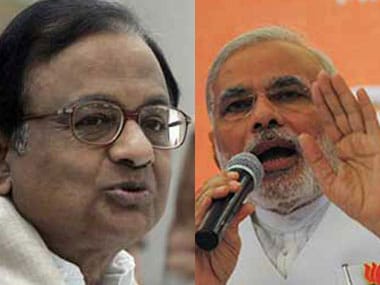 Former union finance minister P Chidambaram and Prime Minister Narendra Modi. PTI[/caption]As this writer pointed out in an earlier piece, there are two key problems with the EPFO-based job study. One, it doesn’t capture data in the informal sector given that EPFO doesn’t cover them. The informal sector is where maximum number of Indians is employed at, majority of them unskilled laborers. This is also the segment where demonetisation played havoc in late 2016 sucking out cash overnight and paralyzing the system for a good six months.The large-scale drift from factory jobs to daily wage jobs under the government’s employment guarantee scheme too signaled that the informal sector is having its own share of problems in the aftermath of the note ban. What can we do to map employment trends in real-time in this segment? The government needs to think deeply on this.Two, there is a seeming disconnect with the key macro-economic numbers and what the Ghosh duo employment study shows. This disconnect is also evident in the consumption, investment trends over the period under consideration. Why would an economy send out differing, contradicting signals?In short, as of now, we do not have a clear picture regarding job creation beyond claims and counter claims. The government and its supporters claim job scenario has actually improved citing success of government schemes such as Mudra Yojana, Stand up India and Start up India but the Opposition is not buying into these claims.Just yesterday (Sunday), Congress leader and former union finance minister P Chidambaram targeted Prime Minister Narendra Modi for his comment that selling pakodas outside an office was also a job, and said that by that standard even "begging" would be called a job . Chidambaram said job and self-employment were two different matter and the two needs to be differentiated when the government talks about new jobs. "In the debate on jobs, it is important to keep the distinction between job and self-employment. A job is certain, regular and reasonably secure. We want to know how many such jobs have been created," Chidambaram said in a tweet.Below-the-belt political barbs and mud-slinging do not take the debate on job data any far. Both the Congress and BJP need to stay away from below-the-belt personal attacks and focus on constructive debates. Perhaps, there is an opportunity for the Narendra Modi government to use this Budget to offer clarity on the job scenario in the country with official data-backed presentation. Perhaps, the government should unveil the lay out a new roadmap to overhaul the process of assessing new job creations which is important for an aspiring economy like India. Job data is a subject in a vast economy like India that needs much more serious discussion beyond ‘pakoda seller’ vs beggar attacks.
First Published:Jan 29, 2018, 09:13:01 IST
Advertisement
Advertisement

'From make in India to launch from India': Skyroot COO on why Vikram-1 could change India’s space sector
Skyroot Aerospace’s successful Vikram-1 mission marks a major milestone for India’s private space sector, as the country seeks to shift from “Make in India” to “Launch from India” and compete in the global commercial satellite launch market
8 min read
Google burns cash for first time as AI spending pushes 2026 capex to $205 billion
Google parent Alphabet reported negative free cash flow of $5.9 billion in the second quarter for the first time since going public, as surging AI infrastructure spending pushed its 2026 capital expenditure forecast to as much as $205 billion
6 min read
Tesla sells more cars but makes less money: Why Musk’s AI pivot is squeezing profits
Tesla’s record Q2 deliveries failed to translate into higher profits as price cuts, falling regulatory-credit revenue and Elon Musk’s aggressive AI spending squeezed margins and pushed the EV maker into negative free cash flow
5 min read
No premium queues, 30-minute target: What changes for Indian passport applicants in UAE
Indian passport applicants in the UAE can now access passport, visa and attestation services through Alhind’s 16 centres, with no premium queues, a Dh19 service fee and a target of completing applications within 30 minutes
4 min read
Bharat Forge, Flying Whales sign pact to develop 60-tonne airships for India’s defence logistics
Bharat Forge has signed an MoU with Flying Whales to jointly develop and manufacture 60-tonne heavy-lift airships in India for defence logistics, strategic mobility and disaster response
3 min read
Advertisement
Advertisement