



Arun Jaitley has tough task to choose between populism and fiscal prudence in Union Budget 2018
In Union Budget, small businesses may get some sops to ease pain caused to them due to chaotic rollout of GST and demonetisation

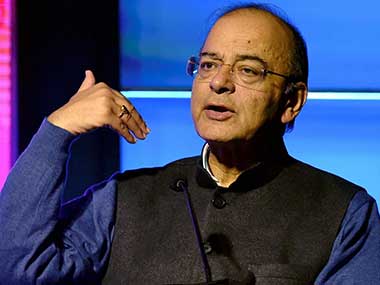
A file image of Arun Jaitley. PTI.[/caption]Prime Minister Narendra Modi seemed to have already lowered expectations of mass voter swaying announcements when he indicated that the Budget may not be resort to populism and that it was a myth that common man wants sop. This will be India's first post-GST and is being keenly watched to see what Jaitley does to boost growth in Asia's third largest economy. There are talks that tax break on capital gains from stock investments may go and it remains to be seen if Jaitley will finally show some movement on his 2015 promise to lower corporate tax rate to 25 percent from 30 percent over four years.He has to manoeuvre all this within limited scope of tinkering with tax rates given that central excise duty, which was levied on goods manufactured in the country, and service tax have both been subsumed in the GST and he no longer has the sole power to fix rates on them. Also constraining him would be the rise in global oil prices, which can stoke inflation as well as widen current account deficit. Some kind of incentives to boost exports of certain sectors may be announced while there may be announcements for start-ups as well as for promoting entrepreneurship.There have been mixed signals on deficit target, with Chief Economic Adviser Arvind Subramanian earlier this week stating that a pause in the fiscal consolidation plan can't be ruled out while Niti Aayog vice chairman Rajiv Kumar saying the government is likely to stick to the target. In the first eight months of 2017-18, fiscal deficit reached 112 percent of the target, stoking fears of a fiscal slippage. The shortfall was largely due to reduced dividends from government companies, which the government looks to bridge through stake sale in state-owned firms like HPCL.Scrapping the colonial-era tradition of presenting the Budget at the end of February, Jaitley had for the first time presented the annual accounts on 1 February last year. The Budget presentation was advanced by a month to ensure that proposals take effect from 1 April, the beginning of the new financial year. Also, the nearly century old tradition of having a separate budget for the railways was scrapped and merged with the general budget. The Union Budget 2018-19 would be the last full Budget of the BJP-led NDA government before the 2019 general elections.As per the practice, a vote-on-account or approval for essential government spending for a limited period is taken in the election year and a full-fledged budget presented by the new government. While P Chidambaram had presented the previous UPA government's vote-on-account in February 2014, Jaitley had presented a full budget in July that year. The Budget for 2018-19 will be the first budget post implementation of the GST regime.Even though independent India's biggest tax reform of GST was implemented from July 1, the Budget for 2017-18 (April-March), had followed the practice of tax revenue projections under the heads of customs duty, central excise and service tax alongside direct tax numbers. With excise duty and service tax being subsumed in the GST, the classifications in the forthcoming budget may undergo change. While a new classification for revenues to be accrued from GST will be included in the Budget for the next fiscal, for the current year two sets of accounting may be presented one for actual accruals during April-June for excise, customs and service tax, and the other for July-March period for GST and customs duty.Click here for full coverage of Union Budget 2018.

Tesla sells more cars but makes less money: Why Musk’s AI pivot is squeezing profits
No premium queues, 30-minute target: What changes for Indian passport applicants in UAE
Bharat Forge, Flying Whales sign pact to develop 60-tonne airships for India’s defence logistics
Air India to cut Delhi-Toronto flight time by 3 hours, resume non-stop services from August 1
South Korea economy grows faster than expected in Q2 as chip exports power recovery