
Advertisement
Co Presented By
Co Presented By


Sections
$140 bn needed by FY19: Why Arun Jaitley will continue to grapple with state-run banks
Unless the government moves without delay to cut stakes in the government banks and make capital available, the finance minister may find it even tougher to handle this problem in the years to come

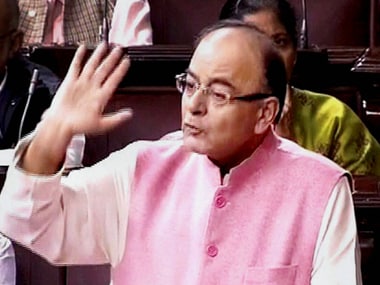 Arun Jaitley. PTI[/caption]The NDA government has said in the past that it would begin lowering stake in state run banks, but not much action has happened yet. Out of the total 27 state-run banks, government holds above 75 per cent stake in at least nine banks.Indian banks will require huge capital by 2019, at least $140 billion (about Rs 9.35 lakh crore) to meet the Basel-III requirements, global rating agency Fitch said in a note on Thursday. The government’s promised capital infusion of $11 billion (about Rs 73,000 crore) would be inadequate to meet state-run banks’ requirements, the agency said.“State-owned banks - which carry a disproportionate share of the stressed assets - have little choice but to look at strengthening balance sheets if they have to revive profitability, internal capital generation and equity valuations in any meaningful way,” the agency said.Under Basel-III, Indian banks need to have a minimum Tier-I (equity) capital adequacy ratio of 7 percent. At least 7 state-run banks currently have their Tier-I below 8 percent or in other words are close to the minimum required capital required. These lenders might need to funds urgently to be compliant with Basel norms.
While Basel-III is one part of the problem, Indian banks need to have large amount of capital to provide for the bad loans.“Any sharp recovery in credit fundamentals appears unlikely with capital and asset quality-related challenges acting as impediments to growth,” said Fitch in the note.Total gross NPAs (non-performing assets) of Indian banks are currently at Rs 300,000 crore. This, coupled with the restructured loan amount, the total chunk of stressed assets will be in early double digits of the total loans given by the banking sector. For every new restructured loan or a failed loan, banks have to provide at least 15 percent of the total loan value as provisions.This works out to too large an amount to be managed by the government’s coffers. The question is who will provide the money to public sector banks, which find it difficult to raise money from markets.While the Reserve Bank of India (RBI) under Raghuam Rajan has initiated efforts to push banks for early recognition of stress in their loan portfolios to cut down future bad loans, the big question is what banks can do with the existing stock of bad assets.“New NPL (non-performing loans) growth has started to slow down across many banks, but resolution of the existing large stock will be a slow and protracted process - as structural challenges in stressed sectors still persist while corporate leverage remains high,” Fitch said.The fact is that the recovery of large corporate loans will happen only when the economic activities pick up momentum, even though banks go out to hunt down the defaulters. Also, a lot will depend upon how effectively the government manages to push key reforms across sectors to improve efficiency.Until then the ‘credit costs are likely to remain high and will continue to be an overhang on earnings growth for a longer period - unless macroeconomic recovery and speedier reforms aid faster asset resolution or banks conduct greater capital-raising to push growth, or both,” Fitch said.Unless the government moves without delay to cut stakes in the government banks and make capital available, the finance minister may find it even tougher to handle this problem in the years to come.
First Published:Dec 10, 2015, 15:57:22 IST
Advertisement
Advertisement

US jobless claims fall to 187,000, signalling resilient labour market ahead of Fed meeting
US jobless claims fall to 187,000 as strong labour market reinforces Fed's inflation focus
1 min read
NDTA asks Connaught Place shops, offices and restaurants to close by 6:30 pm today
NDTA says move follows advisory from NDMC Chairman and Vice Chairman amid prevailing security situation in Connaught Place
1 min read
EU slaps Google with $1 billion antitrust fine over Play Store and Search practices
European Commission says Google unfairly favoured its own services on Search and the Play Store, violating the Digital Markets Act; the company calls the decision harmful to businesses and consumers.
1 min read
Brent crude flirts with $100, reigniting inflation and forex concerns for India
Experts say a prolonged rally above $100 per barrel is unlikely, but sustained high oil prices could push up inflation, widen the current account deficit and pressure the rupee.
2 min read
Can a record May offset a shrunk international schedule and help IndiGo turn a profit?
Record domestic market share boosts operating performance, but forex losses, rising oil prices and geopolitical disruptions could weigh on IndiGo's bottom line.
3 min read
Advertisement
Advertisement