


When time is stretchable: What CBI's latest failure in Badaun gangrape shows
If anything could tell us about how we as a country have utter disregard for time, then it is from the inundation of the graves of the two Badaun girls.

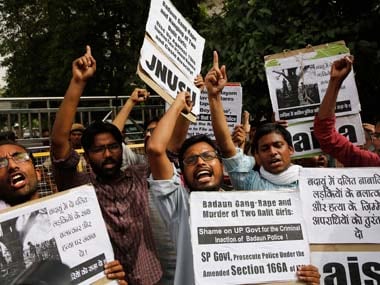
Students in Delhi protesting the Badaun gangrape case. Representational Image. AP[/caption]One does not have to follow the watch or the clock, much less the calendar whose pages can just keep turning without hastening the pace of any work. One should be forgiven to have assumed that the CBI would have made haste to get to the bottom of the mystery: were they raped, were they hanged after they gave up their lives, etc. In this case, since a procedure was not followed in the first instance, the investigators had to willy-nilly, follow the rules like seeking a court nod for exhumation. And courts, we know, are remarkably slow. Perhaps even this specific court that was approached had its own backlog of other cases.Lack of speed, and proclivity to allow adjournments, is the bane of Indian judicial system. The disinclination to do anything in India within a reasonable timeframe leads to the society as a whole being forced to pay the price.How else does one explain people serving time as undertrials much beyond the periods they would have served in jail as punishment? The delays can financially ruin a person by paying the lawyer’s fees because someone or the other wants an adjournment.Had plans been made, problems anticipated and resolved, and work undertaken, the Mumbai Metro and Monorail would not have had time overruns, escalation of costs and the consequent higher tariff for a trip (which again landed up in the courts). It is not just the state and the semi-public organisations that are to be blamed for this, even the private sector has this tendency – time be damned.For instance, every time I crawled in slow traffic alongside a flyover under construction, I used to wonder if the contractor had poor finance managers because there is something called cost of funds. Equipment would have been hired, money borrowed and these push up the final cost of construction.But I was demystified when told that every lag equalled something extra because higher escalations can be secured from the authorities for a consideration. Which means, slower you build, the more profitable it is. It is the public exchequer that suffers, which in turns passes on the costs to the users by toll charges. So a virtue emerges out of a tradition.Long, long ago, a senior colleague in The Hindu’s New Delhi bureau had written an interesting explanation about time and its use. For instance, he had contented, that if people went by rules which specified no timelines for outcomes, a wing of government or a bank could be held to ransom by merely going on a ‘work-to-rule’ campaign. The system can come to a standstill. If a peon was not around to pick up the file indicated and carry it to the next table for further attention, then the file stayed put because it was not the desk officer’s task to carry the file to his colleague just a few feet away. Till the peon arrived, they would indulge in a chat how the chaiwallah was late.That is why perhaps the governments are averse to agree to citizen’s charters which would specify actions in a time bound manner. It is therefore heartening that Narendra Modi has ordered that a file needn’t have more than four stops before it came to him, making the system that time was of the essence.As another example, look at any organisation and their bylaws. Most meetings have a quorum. But waiting half-an-hour after the scheduled hour, meetings can be reconvened and business, however important, can be dealt with later on. The decisions are by those who did not earlier make the quorum.As I said earlier, time’s perverted use as a weapon has been mastered. In India, we have build systems around the disregard for time.
Mahesh Vijapurkar likes to take a worm’s eye-view of issues – that is, from the common man’s perspective. He was a journalist with The Indian Express and then The Hindu and now potters around with human development and urban issues.

Key differences between third party, comprehensive & zero depreciation bike insurance coverage
These lucky members played the CRED bounty and won massive prizes, including Rs 1.5 lakh cash, a PS5, and more: Here’s how you can win as well!
Tech Goes Bold with the New Age Baleno: Everything A Hatchback Wants To Be
How saving water will save our future
‘Dune’ Is A Visual Extravaganza Tied With Spellbinding Performances That You Just Can’t Afford To Miss